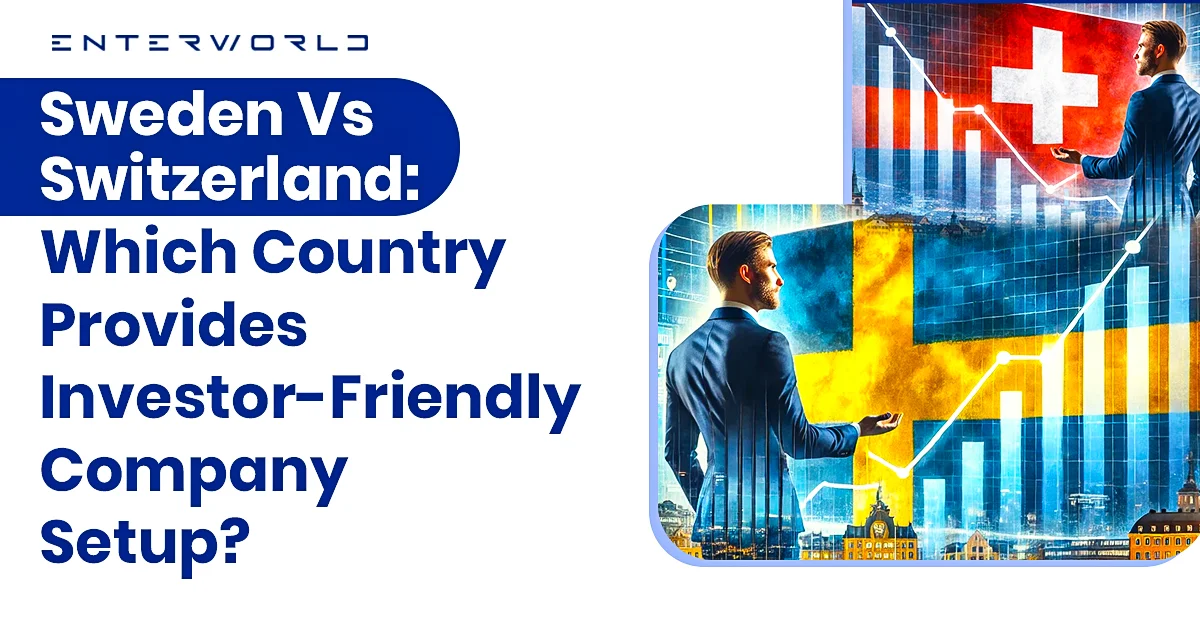
Sweden and Switzerland are two prominent countries offering investor-friendly company setup. Choosing a country for company setup is essential but a difficult task for investors aiming for growth, long-term stability, and profitability. Both countries offer an investor-friendly business environment with transparent rules, supportive policies, favourable taxation, and an efficient administrative process.
Sweden and Switzerland also offer stable economies, skilled workforces, and international connectivity. While both countries offer remarkable opportunities, they differ in prices, tax structures, startup support systems, and bureaucracy.
This blog compares Sweden and Switzerland across various factors, assisting investors in understanding which country better aligns with their business aims, goals, risk tolerance, and growth tactics. After reading this write-up, you will understand whether to go ahead with company registration in Switzerland or Sweden.
Economic and Business Overview of Sweden
Sweden has a vibrant export-driven economy in which innovation and sustainability rank highly. As per the World Economic Outlook report by the IMF for October 2025, global growth is expected to slow down 3.1% by 2026, whereas advanced economies will grow by approximately 1.5%. Plus, the emerging market and developing economic by 4%.
Currently ranked #2 in the Global Innovation Index in 2025, the country performs very well in the R&D segment, the production of high-tech products, and eco-friendly innovations. The country’s favourable business climate, talent, and stable policies make it exceedingly attractive to overseas investors.
Sweden’s Economic Landscape and Innovation Hub Status
The economy of Sweden has always been an example of resilience and innovative economics, boasting high productivity, low public debt, and highly skilled employees. Currently, it is ranked 2nd in the World Intellectual Property Organization’s Global Innovation Index in 2025, just after Switzerland, in terms of R&D investments, patents, and creative outputs. Sweden has always been one of the top innovation hubs in the world, boasting two top innovation hubs, with a focus on digital transformation.
The economic recovery is now in motion, with the real GDP expected to grow at 1.5% in 2025 according to the European Commission/IMF, due to the recovery in household consumption, with lower inflation and supportive fiscal policies. The export-oriented economy has continued to significantly impact the global high-value manufacturing and services sectors. The commitment of the Swedish government to sustainable development, combined with the best information technology infrastructure and education systems that emphasize lifelong learning, makes Sweden a leader in adopting the Fourth Industrial Revolution.
Read more – How to Register a Company in the Cook Islands
Key Industries Attracting Investors
In the Swedish economy, the major sectors that attract significant foreign direct investments are the country’s major industries, such as advanced manufacturing, information and communications technology, life sciences, cleantech, and renewable energy.
Stockholm has also grown to become one of the most prominent startup hubs in Europe, referred to as the “Unicorn Factory,” because of successful startups such as Spotify and Klarna that have originated from this city. Green tech is also thriving in Sweden because of the country’s strong focus on sustainable solutions, the circular economy, and clean transition solutions in the area of energy. Sectors such as telecommunications, healthcare, financial services, and the forestry industry segments also offer high value to investors.
In 2025, the areas of focus that are encouraged by Business Sweden include digital growth, sustainable technologies, and life sciences, in which innovative knowledge creates a non-competing test market that is second to none in the whole world for global corporations. The sectors are linked to optimal infrastructure, very high R&D intensity, and public innovation ecosystems that attract a lot of FDI in high-growth areas of tomorrow.
Government Support for Startups and Foreign Investment
The Swedish government has an array of initiatives to encourage startups and investments in Sweden. These include Vinnova (innovation funding), Almi Invest (venture capital investments), and Business Sweden (investment promotion). Such incentives include Research and Development credits, funding for innovative projects, qualified tax relief for important key personnel (20% deduction on social security R&D personnel and 25% income tax for eligible foreign key personnel), and regional subsidies in disadvantaged regions.
Schemes focus on cleantech, life sciences, and information technology with the help of non-dilutive financial grants, investments, and incubator space. Foreign investors operate with little to no restrictions and benefit from the same treatment, easier business setup mechanisms, and market access in the EU. Sessions such as the Join Sweden Summit also help in international networking and setup for entrepreneurs.
Economic and Business Overview of Switzerland
The Swiss economy is extremely advanced and stable, and is renowned for innovation, intelligence, and financial acumen. The GDP growth in 2025 for EU is expected to be 1.2% to 1.4% in real GDP, which is a result of a stable economy in a global economy that is filled with uncertainty. The economy has been rated 1 in the Global Innovation Index in 2025, in which Switzerland is a leader in research and development, precision industries, and sustainable development.
Company registration in Sweden is a great way to build a flourishing entrepreneurial space in the Swiss economy.
Switzerland’s Reputation as a Global Financial Center
Switzerland has indeed been synonymous with global finance, as Zurich and Geneva have been constantly among the top financial cities in the Global Financial Centres Index. By 2025, this reputation is a product of centuries of banking secrecy, now revamped for transparency, political neutrality, and sound regulatory frameworks that ensure stability and trust. It is one of the significant contributors to GDP, covering private banking, wealth management, asset management, and insurance.
Switzerland, with powerhouses like UBS and global players in commodities trading, manages trillions and therefore attracts high-net-worth individuals and institutions from all over the world. Whereas Denmark had a relatively easy run, facing fewer challenges compared to Switzerland, with the 2023 integration of Credit Suisse into UBS and changing international tax standards, adherence to OECD guidelines, and anti-money laundering by the country have given it an edge.
Low corporate tax in some cantons, coupled with good infrastructure and a multilingual talent base, strengthens its position as the top safe haven for international capital, with a high ranking in competitiveness and innovation-driven financial services.
Read more – How to Register a Company in Oman as a Foreigner?
Dominant Sectors for Investment
The key industries in Switzerland’s foreign investments are pharmaceuticals & life sciences, precision engineering & machinery, financial services, IT, and clean tech. The pharma & biotech industry, represented by Novartis and Roche, is responsible for enormous R&D spending as well as high-quality exports.
Precision sectors, include watches, medical, and manufacturing industries. These take advantage of Swiss engineering skills. Financial and insurance business activities are central to the economy, with reinsurance operations located in Zurich. Growing sectors in fintech, blockchain, and sustainable technologies drive venture capital, reflected in innovation hubs in Zurich, Geneva, and Basel. Manufacturing, especially chemicals and machinery, is a major recipient of FDI.
According to Switzerland Global Enterprise (S-GE), high-priority sectors include ICT, medtech, and deep tech. These industries enjoy the strength of top universities in the world, a risk-free environment, and access to EU markets through bilateral agreements. Returns on investment are high in these industries because they are globally competitive with robust IP protection and an innovative and qualified workforce.
Policies Promoting International Business
International business in Switzerland is facilitated by liberal foreign investment policies, with minimal restrictions outside critical industries such as property and financial services. Foreign investors are granted national treatment, giving them blanket access without FDI screening, except that a regime for critical infrastructure is pending discussion in 2026+.
Organizations such as Switzerland Global Enterprise promote and attract FDI by offering incentives, including cantonal tax breaks, R&D subsidies, and simplified permit procedures. Bilateral investment agreements, FTAs, and market access to the EU improve protection mechanisms.
The implementation of Pillar Two minimum tax for OECD countries ensures that this tax requirement is met while still being competitive. Political stability, robust intellectual property rights, and effective bureaucracies make it easy for international business operations to move headquarters.
Company Formation Process in Sweden & Switzerland: A Step-by-Step Comparison
Setting up a company in Sweden and Switzerland involves structured legal steps, clear documentation, and regulatory approvals. Though both countries have transparent and reliable systems, their differences lie in timelines, capital requirements, and administrative complexity. The comprehension of these step-by-step processes provides investors with an opportunity to choose jurisdictions that would best address the expectations of speed, flexibility, and compliance.
Requirements and Timeline in Sweden
Setting up a company, especially an AB/limited liability company, is streamlined and business-friendly in Sweden. First to be fulfilled is the minimum share capital requirement, which stands modestly against most of the capital requirements across many European Union (EU) countries. Documents to be prepared by the founders include the Memorandum of Association (MoA), Articles of Association (AoA), and proof of depositing the capital in a bank account in Sweden.
When the documentation is ready, the company is registered with the Swedish Companies Registration Office, Bolagsverket. It usually takes about one to two weeks if the documents are complete and accurate. Once the registration is done, the company needs to apply for tax registration with the Swedish Tax Agency, Skatteverket, including VAT and employer registration if required.
It may take a little more time for foreign investors, especially if they need to appoint a local representative or open a bank account, among other things. Overall, Sweden offers good predictability at relatively favorable average speeds of setting up a business and is thus quite appealing to both domestic and foreign investors, especially to startups and technology-oriented businesses.
Requirements and Timeline in Switzerland
Starting a company in Switzerland is streamlined but more formalized, and this largely depends on the canton in which the company is being set up. If starting a company in Switzerland, most foreign investors opt to create a GmbH or an AG, which both require a higher capital requirement compared to Sweden. One important aspect regarding company incorporation in Switzerland is the requirement to notarize company documents.
A Swiss bank account must be opened by the founders to deposit the initial share capital. Subsequently, registration with the Commercial Register of the canton and publication in the Swiss Official Gazette of Commerce takes place. This normally takes between two and four weeks, depending on the canton and the readiness of documents.
Other registrations might encompass value-added tax, social security, and industry-specific licenses. Though it takes a bit longer, the Swiss system provides legal certainty, high credibility, and flexibility because of cantonal regulations.
Ease of Registration and Digital Tools
Sweden is notable for its advanced IT infrastructure, and it has the capacity to register and comply with the process by using governmental online portals. Electronic identity and online services improve the process by eliminating the need for paper and hence delays. Switzerland is also modernizing the process, but it involves more documentation and notarization. Therefore, Sweden provides an easy process, while Switzerland provides a precise and legal process.
Taxation Systems and Incentives for Investors
A tax regime is one of the key pillars in analyzing investor-friendly countries. Both Sweden and Switzerland are known for their favorable, reliable, and competitive tax treatment for businesses, although they are quite different in design and flexibility. Sweden has an optimized tax system, which is centralized, while Switzerland, being decentralized, has enough flexibility to evaluate tax optimization for businesses.
Corporate Tax Rates and Structures in Sweden
Sweden has a flat corporate income tax rate at the national level, providing a simple taxation system that is very attractive to investors. The fact that there is no secondary level of corporation tax at a local level, in either a region or a municipality, may not be very attractive from small to medium-sized businesses that require clear taxation systems.
Additionally, Sweden has beneficial participation exemptions, where dividends and capital gains derived from qualified subsidiaries are tax-exempt. Furthermore, losses incurred in a business are generally freely portable for an indefinite number of years, which is beneficial for startups and fledgling businesses. Although Sweden is not marketed as a low-tax destination, its tax system is complemented by excellent public services, high-quality infrastructure, and a high degree of tax certainty, which may appeal to investors interested in sustainable development and operational reliability.
Corporate Tax Rates and Structures in Switzerland
The corporate tax regime of Switzerland is recognized for flexibility and competitiveness. It is taxable at three different jurisdictions: federal, cantonal, and municipal levels. Due to this the tax rates vary from place to place. The cantons are also competing among themselves to lure businesses with taxes that are lower, due to which location factors play an important role for investors.
The federal rate of corporate taxes in Switzerland is considered moderately high. Although when compounded by cantonal and municipal taxes, the net effect could be less onerous than in other European countries. Switzerland has certain favorable tax conditions specifically designed for holding and innovation-driven businesses. As beneficial as the current system appears in terms of optimizing taxes, it is not entirely simple to manage.
Tax Breaks, Deductions, and Double Taxation Treaties
Both Sweden and Switzerland have tax incentives that target investment, innovation, and doing business internationally. Sweden’s tax incentives include R&D deductions, innovation incentives, and reduction of employers’ contributions, primarily targeting tech startups and R&D companies.
Switzerland presents a number of sophisticated tax incentive schemes, such as patent boxes, R&D super deductions, and innovation-driven tax reliefs at a cantonal level. Such tax regimes result in significantly lowered taxable bases when appropriately structured.
Moreover, both nations have vast networks of double taxation agreements with the world’s biggest economies. This aids in ensuring that double taxation is avoided and makes it easier to repatriate profits across borders. It also enables foreign investors to enjoy better certainty and security as they expand across the globe.
Regulatory Environment and Compliance
A clear and trustworthy regulatory framework supports the confidence of investors. Both Sweden and Switzerland have robust legal frameworks, fast and friendly environments in the compliance process, and high standards of governance. But the two have variations in the way of regulation, the administrative environment, and the degree of freedom in the labor market.
Business Regulations and Bureaucracy in Sweden
Sweden is well-known for business-friendly regulatory framework in which transparency and efficiency are emphasized. Business regulation is largely standardized at a national level, which means there is less uncertainty in this area, and most regulatory procedures can be done through technology that saves paperwork.
Although Sweden is known for being a country with easy business procedures, adherence to stringent regulations in some domains, such as taxation, labor, and data privacy, is mandatory. If one chooses to incorporate in Sweden, labor laws focus on protecting employees’ rights, hence incurring more responsibilities for entrepreneurs.
In general, Sweden provides a stable regulatory framework that satisfies long-term investors who prefer predictability, digital effectiveness, and institutional trust.
Business Regulations and Bureaucracy in Switzerland
The regulatory system that Switzerland provides to its companies is very structured and rigid from a legal point of view. It has business regulations that come under federal as well as state law. This leads to some variations depending on the state in which the business operates. This manner can be complex, but it leads to flexibility to some extent, as companies have the freedom to locate in a state that offers better regulatory terms.
Administrative matters are highly organized but more often formalized in comparison to their Swedish counterparts. It involves paper bureaucracy and notarization. Upholding standards of compliance, especially in finance, public service, and the filing of documents, is a priority. But the relevant agencies are famous for being professional and responsive.
A major attraction for investors is that the regulatory framework in Switzerland provides credibility and international respect. This is particularly attractive for financial service organizations and multinational companies.
Intellectual Property Protection and Labor Laws
Both Sweden and Switzerland have a firm level of intellectual property rights, which conform to world standards, ensuring proper legal protection in patents, trademarks, and copyrights. Sweden’s labour regulations place more importance on the protection of employees, which hampers their flexibility. Switzerland has more flexible labour laws with high employment standards, which give companies more flexibility in handling their personnel.
Read more – How to Register a Company in Iceland as a Non-resident?
Cost of Setting Up and Operating a Company
Starting and operating costs associated with starting any firm are also very important factors that must be considered by investors. Sweden and Switzerland present investors with excellent operating environments, however, cost arrangements differ significantly. Sweden presents a more favorable start and operating costs associated with administrative procedures. On the other hand, operating in Switzerland is expensive because of personnel costs, property rates, and expertise.
Initial Setup Costs in Sweden vs. Switzerland
Sweden has moderately low startup costs, with minimal initial share capital and small registry fees, especially due to digital registration systems, which further lower these costs. Legal and consulting expenses in Sweden are moderate and may not be prohibitive for startups and small businesses.
Switzerland, on the other hand, entails more incorporation costs. Startup capital requirements are higher, with additional costs in terms of notarization, commercial registration, and advisory fees. Even so, Switzerland has higher incorporation costs to pay for its excellent legal framework, reputation, and capital market infrastructure.
Ongoing Operational Expenses
Swedish operating costs can be classified as average, with efficient digital administration and stable taxes making these costs predictable. However, social security contributions, as well as employment-related costs, can be relatively higher because of strict employee protection policies.
Switzerland also has some of the highest operational expenses in Europe, especially in the areas of personnel, office facilities, and professionals. However, the level of productivity in Switzerland is high, and the flexibility of the working population could compensate for the expenses. Many investors are willing to pay the extra cost to hire talent.
Hidden Costs and Financial Planning Tips
Investors must factor in the following hidden costs:
- Reporting for regulatory compliance
- Accounting fees
- Exchange rate risks
- Regulatory notices.
In Sweden, collective labor agreements can contribute to higher employment costs. In Switzerland, disparities between cantons can generate different taxes and fees.
Financial planning, taking advice from local experts, and optimal domicile selection within each country can greatly help in cost-effectiveness and profitability.
Investor Support Services and Ecosystem
Both Sweden and Switzerland create a conducive support environment for the investor, with government support initiatives, as well as private endeavours and global networking. This support environment provides the needed counseling, investment opportunities, networking, and professional services for the growth of startups and foreign investments. Though Sweden focuses on innovation parks and online support services, the financial and multinational business network of Switzerland is tapped into. Recognizing the support structures in place enables the investor to acclimate to the challenges of doing business in the countries with increased efficacy.
Networking, Incubators, and Funding Opportunities in Sweden
Sweden has a thriving startup community, with several incubators, accelerators, and innovation spaces, especially in cities such as Stockholm, Gothenburg, and Malmö. Networking opportunities through events, meetups, and startup communities, along with access to funding, support from facilitators like SUP46, Sting, and Nordic Innovation, make startups attractive to investors, especially in areas like green technology and life science. In this the government grants or venture capital are provided to startups with high growth potential. The presence of a strong innovation and digital infrastructure network in Sweden is what attracts investors to this country, allowing them to experience a dynamic working community while doing business in Sweden.
Networking, Incubators, and Funding Opportunities in Switzerland
Switzerland has established itself as a complete ecosystem for investors by offering world-class incubators, accelerators, and co-working facilities. Also, it gives access to global finance and multinational networks. Most importantly, organizations such as Fongit, Venturelab, and Switzerland Innovation support startups by mentoring them, providing seed capital, and facilitating access to international markets.
Venture capital and private equity are in abundance, especially for startups working in the fields of Fintech, biotechnology, and precision engineering. Networking events and industry conferences can also serve to forge strategic partnerships. Switzerland’s ecosystem of stability and innovation, with its considerable international reach, considerably attracts investors seeking to scale up businesses in a financially and legally secure environment.
Visa and Residency Options for Foreign Investors
Both Sweden and Switzerland have visa and residency programs to help attract foreign investors and entrepreneurs. Sweden has the “Startup Visa” targeted at entrepreneurs who intend to start innovative businesses, enabling them to receive residence permits for founders and family members. Switzerland gives residence permits to investors who make significant economic contributions or establish a company, some cantons offer streamlined processes.
Long-term residency and eventually citizenship pathways in both countries are available to qualifying investors. These programs should make relocation easier, facilitate investment, and enhance international talent, therefore helping to make cross-border business more accessible and secure.
Conclusion
Sweden and Switzerland present extremely favourable settings for investors, although they differ in what they focus on. Sweden impresses with its digital efficiency, affordable pricing, easy registration, and favourable innovation infrastructure. It is, therefore, the best choice for startups and technology-based businesses.
In its turn, Switzerland impresses investors due to its favourable tax rules, strong legal system, global recognition, and advanced financial infrastructure. Therefore, Sweden encourages fast growth, cost-effectiveness, and innovativeness. In contrast, investors seeking stability and optimal tax treatment will be attracted by the favourable settings that Switzerland presents. In any case, Sweden and Switzerland rank among the premier destinations for investments.
Talk to our experts at Enterworld for a 30-minute free consultation on business setup in Sweden or Switzerland.
Frequently Asked Questions about Sweden vs Switzerland Company Setup Comparison
According to the World Bank’s 2020 Doing Business Report, Sweden’s overall business environment is among the most business-friendly, ranking ninth. Sweden was placed eighth out of 141 nations in the World Economic Forum’s 2019 Competitiveness Report for productivity and overall competitiveness.
With businesses like Ericsson and Spotify setting the standard for international telecoms and digital entertainment, Sweden is well known for its technological innovation. The Swedish IT industry is renowned for emphasising automation, cutting-edge software development, and sustainability.
The recovery has started, and GDP growth has been a little higher than anticipated. In the future, growth is anticipated to be mostly driven by domestic demand. Household consumption is predicted to rise in 2026 due to pent-up spending and rising salaries.
Although it faces difficulties due to its reliance on Eurozone trade and ageing population, Switzerland has a highly developed, inventive, free-market economy that ranks among the richest in the world by GDP per capita. It is driven by industries like banking, insurance, pharmaceuticals, and luxury goods and is backed by a skilled workforce and robust infrastructure.
Switzerland is a global leader in high-quality, high-tech products because its primary industries are high-value manufacturing (chemicals, pharmaceuticals, machinery, watches) and services (banking, insurance, tourism), which drive exports of specialised goods and financial expertise and are backed by a skilled workforce and innovation in fields like biotech and artificial intelligence.
Many overseas investors find Switzerland’s regulations and fiercely competitive economy to be appealing. Its highly qualified workforce makes it an undeniable hub of innovation.
You belong to the richest 20% of the population if your household makes 97.500 Swiss francs annually (before taxes). This increases to 167,000 francs annually to be in the top 5 percent, and 1.2 million francs annually to be in the 0.1 percent.
“Services” are the economy’s most significant component. This covers travel, insurance, and banking. Another significant sector of the economy is farming.
Read more – How to Register a Company in Turkey as a Foreigner?

Florida LLC for Amazon FBA: Ultimate 2026 Guide...
Mar 16, 2026
How to Register a Company in Dubai Silicon Oasis...
Mar 10, 2026

How to Start Logistics Business in Oman in 2026?...
Mar 03, 2026

How to Start an Interior Design Company in Dubai...
Feb 25, 2026
The Top 8 Benefits of Incorporating a Company in...
Feb 02, 2026
Startup Tax Exemption Singapore 2026: A Complete...
Jan 28, 2026

Australia Corporate Tax & Incentives: Update...
Jan 22, 2026

How to Set Up a Company in the United States: 20...
Jan 22, 2026

Annual Compliance Calendar in Australia 2026: Al...
Jan 21, 2026

Foreign Ownership Rules in the United States: Wh...
Jan 20, 2026