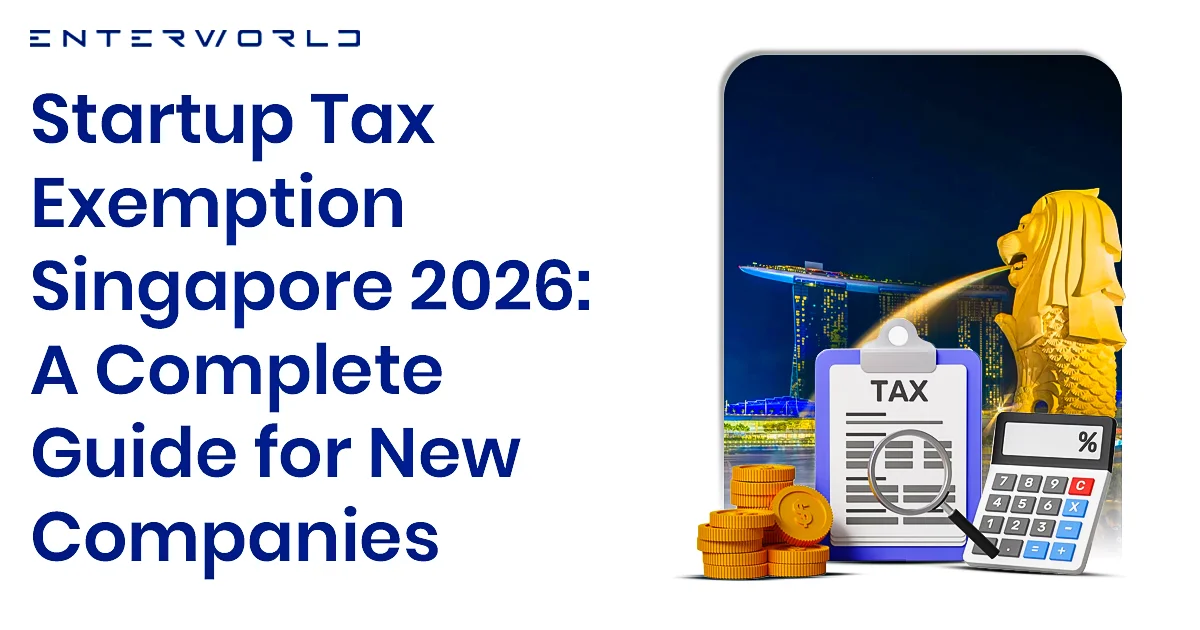
The startup tax exemption in Singapore 2026 is a major reason why entrepreneurs who want to establish startups are giving their first thought on Singapore. This article provides information about the Singapore startup tax plan and covers information regarding eligibility for Singapore SUTE, as well as savings for companies that take advantage of the Singapore corporate tax exemption.
Singapore positions itself as one of the most favourable regions for businesses, owing to its pro-business policies, streamlined financial and regulatory structures. The Startup tax exemption Singapore in 2026 covers the Startup Tax Exemption (SUTE) and Partial Tax Exemption (PTE) treatment structures for newly formed businesses. This provides businesses with structured relief for their tax treatment of taxable income.
Plus, among the key pro-business factors for startups, Singapore corporate tax exemption is mandated for companies in the early years of business. The country helps businesses sustain their funds and extend the period of growth during the early stages of the business’s lifecycle.
It is crucial for Singapore business setup enthusiasts to understand the Singapore startup tax scheme and your Singapore SUTE eligibility to reap the maximum benefits of the Singapore corporate tax exemption.
What is the Startup Tax Exemption (SUTE) Scheme?
The Startup Tax Exemption (SUTE) scheme is the base of Singapore’s startup tax scheme. It is specifically designed to lighten the financial load of newly incorporated companies.
SUTE was introduced to stimulate entrepreneurship and innovation, especially during the formative years of a startup’s operations. It achieves by helping startups to preserve working capital through a reduction of effective tax rates. Also, it encourages reinvestment to fuel growth and strengthen a competitive position.
The enhanced framework support companies eligible under the Singapore corporate tax exemption in the framework for 2026. In this case, new ventures will not be constrained by early-stage tax burdens but instead focus on scaling up.
Purpose of SUTE for New Companies
Major purposes of SUTE for mew companies are given below:
- Promotes entrepreneurship: The barrier to entry is low for first-time entrepreneurs.
- Facilitates Cash flow: It reduces the current tax liability, thereby generating funds
- Fosters reinvestment: It encourage startups to invest money back into expanding their businesses.
- Enhances competitiveness: It makes Singapore a global hotbed for startups.
- Facilitates compliance: It provides an organised format regarding tax relief.
Breakdown of Benefits for Exemption
Have a look at the breakdown of benefits for exemption-
- 75% exemption for the first SGD 100,000 of taxable income.
- 50% exemption on the next SGD 100,000 of taxable income.
- During the first 3 years of assessment, it is applicable, resulting in maximum relief during the initial phase.
Singapore SUTE Eligibility: Eligibility Criteria for the Startup Tax Exemption
To take advantage of the SUTE in Singapore 2026, the relevant organisations must be eligible under the Singapore startup tax scheme. These conditions guarantee that the tax relief is granted to eligible startups and not merely to funds that can be viewed as passive economic structures.
The system promotes economic participation in Singapore by awarding organisations that take part in innovative and development activities in the country. It is essential to comply with the Singapore SUTE eligibility for the founder or the financial decision-maker.
Read more – Licensing Needs for Digital Lending Platforms in Singapore under MAS Regulations
Eligibility Conditions for Singapore SUTE
You are eligible for Singapore SUTE under following conditions. See below:
- Incorporated in Singapore: The firm has to be incorporated under Singapore law.
- Tax residence status: The company has to be controlled and managed in Singapore.
- Maximum 20 shareholders: The number of shareholders may be no more than 20, including both individuals and corporate entities.
- Presence of at least one individual shareholder with a stake of ≥ 10%: One individual shareholder with a stake of at least 10% is mandatory.
- Active trading company (not merely a holding/ investment entity): The company has to be involved in real business, as it cannot be simply an investment firm.
Who is Not Eligible for the Startup Tax Exemption in Singapore?
Not all businesses qualify for the Startup Tax Exemption scheme. IRAS excludes several categories to make sure that only genuinely active enterprises reap the benefits of the scheme. Companies in the following categories do not qualify for the SUTE:
- Holding investment company.
- Property development firms.
- Companies without qualifying individual shareholders.
- Tax-residency Companies that don’t have tax-resident status.
- Dormant or shell companies that do not actually operate.
How much Tax Singapore Startups can Save?
The Startup Tax Exemption (SUTE) Singapore 2026 provides a significant tax savings opportunity compared to the standard corporate tax rate, which stands at a flat 17%. It is worth noting, however, that the exemption only applies to a company making taxable profits.
In other words, this is to ensure that tax exemptions are provided to working business owners and not to dormant business owners that are essentially investment entities.
Example:
Taking a hypothetical example of a company, if the taxable income is SGD 400,000 during the Year of Assessment.
Under the Singapore Startup Tax Exemption (SUTE) scheme:
- The first SGD 100,000 is exempt at 75%, and the amount to be taxed is SGD 25,000.
- The second SGD 100,000 is exempt at 50%, and the amount to be taxed is SGD 50,000.
Adding SGD 200,000 to the taxable amount for the remaining SGD 200,000, which is fully taxable. In this case, the company has to pay total taxes on a taxable income of SGD 275,000 instead of SGD 400,000.
This results in a tax payment of SGD 46,750 at a corporate tax rate of 17%, compared to SGD 68,000 without the exemption. Consequently, the savings would amount to SGD 21,250, providing a significant boost to early-stage cash flow.
Read more – Australia Corporate Tax & Incentives: Updated rates & Exemptions 2026
Comparing Singapore’s SUTE vs Full Corporate Tax Rate 2026
Get a clear comparison between SUTE vs Full corporate tax rate 2026 based on taxable, taxable after exemption, and tax payable in Singapore.
| Conditions | Taxable Income (SGD) | Taxable After Exemption (SGD) | Tax Payable at 17% (SGD) |
| Full corporate tax | 400,000 | 400,000 | 68,000 |
| SUTE Applied | 400,000 | 275,000 | 46,750 |
The above illustrates how eligibility for the Singapore SUTE scheme reduces the amount of tax startups must pay. Subsequently, it allows them to expand their businesses further.
Partial Tax Exemption (PTE) after your Startup Phase
After the completion of the initial 3-year Startup Tax Exemption (SUTE), Singapore businesses are also able to enjoy tax relief through the Partial Tax Exemption (PTE) scheme. This system makes sure that companies are always competitive and financially stable, even beyond the startup phase.
75% Exemption on the First SGD 10,000
Under PTE, the first SGD 10,000 of taxable income is exempted by 75%. This ensures that small businesses are taxed less, as their profits are used for their stabilising process, as businesses are beyond the initial startup years.
50% Exemption on the Next SGD 190,000
The next SGD 190,000 of taxable income is eligible for exemption at a rate of 50%. This considerable tax concession ensures that medium-sized growth is taxed at a lower rate, giving companies a chance to reinvest in growth.
Continued Support Beyond Startup Phase
These exemptions apply to taxable income of up to SGD 200,000 each year, allowing companies to benefit from reduced effective tax rates while reinvesting more capital into business growth. In the run-up to the closure of the startup scheme, PTE will enable firms to continue sustaining themselves and competing effectively even after the expiration of the startup scheme’s time frame.
Common Mistakes for businesses in Singapore to Avoid for SUTE
For businesses in Singapore to adequately leverage from the Startup Tax Exemption (SUTE) scheme, specific rules must be followed and complied with by the relevant authority, the Inland Revenue Authority of Singapore (IRAS). Following those rules, the commonly errors in compliance and mistakes for Singaporean businesses are given below:
- Lack of genuine local operations: A business must prove its genuine operations in Singapore. A shell company or a genuine offshore company might lose its status or eligibility for exemption.
- Inadequate recording: Failure to properly record books, loss of invoices, and discrepancies in statements may cause IRAS to disallow exemption statements. To prove compliance, adequate documentation is very much needed.
- Inappropriate exemption eligibility year computation: Inaccurate computation of the SUTE period of three years or overlapping years of assessment can generate errors related to exemptions.
How to File for Startup Tax Exemption in Singapore 2026?
The benefits enjoyed by Singapore startups under the tax treatment is easy filing of application for exemption. This comes into effect once the corporate income tax returns are submitted via the IRAS myTax portal. Startups need to ensure the accuracy of the information along with the eligibility criteria.
Filing Steps and Tips
- IRAS myTax portal login: Use CorPass to log in to the IRAS myTax portal.
- Choose Form C-S or Form C-S (Lite): Companies with simpler tax situations are required to use Form C-S (Lite); others are required to use Form C-S.
- Correctly declaring the taxable income: Make sure that profits are declared correctly because exemptions only apply after taxable income has been created.
- System automatically applies exemptions: After net income is declared, IRAS will automatically compute the amount for the Startup Tax Exemption (SUTE) or the Partial Tax Exemption (PTE).
- Be prepared to provide supporting documentation: Have copies of invoices, financial statements, and shareholders’ information available for audit purposes if asked by IRAS.
- Verification of Eligibility prior to filing: Validate incorporation, tax residency, and shareholders.
- File on time: It is essential to file the return within the required timeline to avoid consequences.
Beyond SUTE: Other Singapore Tax Incentives
Although the Startup Tax Exemption (SUTE) scheme offers tremendous tax reliefs during the first 3 years, the government of Singapore offers other tax incentives that companies can benefit from even after the startup stage.
The schemes not only promote innovation, productivity, and sustainable growth but also help companies remain competitive.
- Corporate income tax rebate: This rebate is introduced from time to time by the government. This rebate lessens the total tax liability and is complemented by additional relief. This announcement is made through the budget every year.
- R&D deduction: Companies that invest in research and development quality for increased deduction benefits for eligible expenses. The tax incentive supports innovation, technology development, and the emergence of new products and processes.
- Industry-specific schemes: In addition to the general schemes offered to businesses in the economy of Singapore, the industry-specific schemes include finance, manufacturing, and green technology.
Together, these schemes, SUTE and PTE, provide a well-rounded system of taxation support for startups, together with other incentives that enable firms to fully optimise their cost savings while directing these towards expanding and optimising their market position in Singapore.
How the Startup Tax Exemption Supports Long-Term Financial Planning?
More than just short-term tax relief, startup tax exemptions in Singapore have strategic significance for enabling businesses to plan for their long-term growth on a sustainable basis.
By reducing the effective corporate tax burden during the early and post-startup periods, companies can retain more capital for reinvestment in talent acquisition, technology, market expansion, and the scaling-up of operations. In addition, these exemptions provide predictability in cash flow planning as founders and their finance teams can decide with greater financial certainty.
Anchored to sound compliance and forward-looking tax planning, this becomes a critical component of the broader economic strategy a company would adopt in Singapore.
To Wrap Up
Singapore’s startup tax regime grants exemptions and partial relief. It provides strategic savings for new companies to conserve valuable capital and reinvest this amount in growth.
Qualification depends on factors such as incorporation, tax-resident status, shareholder structure, and genuine local operations, ensuring that only authentic and active businesses derive benefits. In addition to this initial 3-year Startup Tax Exemption, the Partial Tax Exemption schemes provide further sustainable relief, and reinforce financial long-term planning.
If you are willing to launch or scale up your business in Singapore, now is the time to contact Enterworld’s tax compliance specialists to maximise your tax exemptions while ensuring full regulatory compliance.
Read more – Best Business Opportunities in Jordan
FAQs on Startup Tax Exemption Singapore 2026
Yes, IRAS conducts tax-exemption scheme audits to examine tax returns and assess operational presence, structural makeup, and finances to determine whether exempted entities fulfil the requirements for exemption.
Yes, tax exemption privileges can be withdrawn if companies lie on eligibility requirements, fail compliance tests, or have no real operations or business in the locality. IRAS may withdraw the tax concession benefits and penalize the company for any misrepresentation.
Sometimes, startups may misunderstand exemption years, lack an actual local presence, or keep poor records, which may result in disqualification from SUTE or PTE status.
IRAS assesses corporate submissions for eligibility, validates tax residency, analyses share structures, and audits financial statements for companies before exempting them from startup taxes.
No, there is no separate application. It will be automatically applied in the filing of Form C-S or Form C-S (Lite) via the IRAS myTax portal.
You are required to file corporate income tax returns with financial statements that are balanced, invoiced, along with shareholder details and supporting records. These are needed when IRAS requests them to support its eligibility and exemption claims.
Following the SUTE period of 3 years, businesses require to apply the Partial Tax Exemption (PTE), benefiting from exemptions on taxable profits.
Yes, the companies can benefit from the Partial Tax Exemption (PTE) every year after the startup phase if they are able to make taxable profits.
Startups benefit from the corporation tax exemption in Singapore through SUTE, which provides material relief for taxable income and benefits for cash flow through Partial Tax Exemption (PTE).
Under the Singapore startup tax scheme, there is a 75% exemption on the first SGD 100,000 of taxable income and a 50% exemption on the next SGD 100,000 of taxable income for the initial 3 years of assessment.
Startups can obtain a maximum savings of SGD 21,250 from taxable income of SGD 400,000 under the SUTE.
No, as these reliefs apply to taxable profits earned by a business, startups that operate at a loss cannot claim these taxation benefits because no taxable income is created.
Under Singapore SUTE eligibility, foreign-owned companies that are incorporated in Singapore can qualify if they achieve tax-resident status, shareholder limits, and active trading requirements.
Singapore companies are not automatically exempt from tax; they have to meet certain qualifying conditions and ensure that their application for exemption is filed correctly before they can access benefits under the Singapore Startup Tax Exemption (SUTE) or the Partial Tax Exemption (PTE).

Florida LLC for Amazon FBA: Ultimate 2026 Guide...
Mar 16, 2026

How to Register a Company in Dubai Silicon Oasis...
Mar 10, 2026
How to Start Logistics Business in Oman in 2026?...
Mar 03, 2026

How to Start an Interior Design Company in Dubai...
Feb 25, 2026
The Top 8 Benefits of Incorporating a Company in...
Feb 02, 2026
Startup Tax Exemption Singapore 2026: A Complete...
Jan 28, 2026
Australia Corporate Tax & Incentives: Update...
Jan 22, 2026

How to Set Up a Company in the United States: 20...
Jan 22, 2026

Annual Compliance Calendar in Australia 2026: Al...
Jan 21, 2026

Foreign Ownership Rules in the United States: Wh...
Jan 20, 2026