Introduction
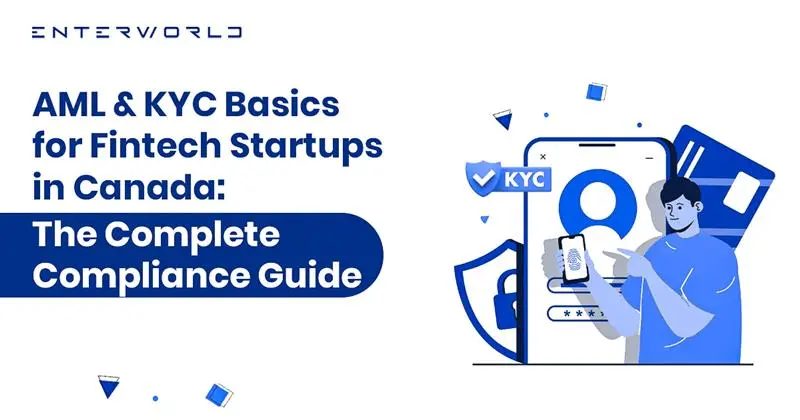
Understanding AML and KYC basics for fintech startups in Canada is crucial for establishing customer trust, achieving long-term scalability, and securing regulatory approval.
Canada’s fintech ecosystem is showing phenomenal growth, as startup businesses are rapidly innovating across lending, remittances, payments, cryptocurrency exchange and neo-banking. With this growth, it has created new opportunities for the businesses and the customers, while strengthening the regulatory environment.
To address money laundering and terrorist financing, the Canadian government has strengthened its framework through the Financial Transaction and Reports Analysis Centre of Canada (FINTRAC). The founders of fintech startups must implement FINTRAC compliance basics into their operations from the outset, whether dealing with AML requirements for Canadian fintech startups or navigating KYC rules for Money Services Businesses (MSBs) in Canada.
Fintech companies in Canada have built a strong AML compliance program that covers ongoing monitoring, risk assessment, and mandatory reporting. This program helps in avoiding penalties, grow safely and sustainably, and protect their reputation.
Learn More : How to Register an Import-Export Code (IEC) in Dubai?
A platform like Enterworld helps fintech startups build and maintain a strong compliance framework. It provides end-to-end compliance automation and simplifies AML and KYC workflows, enabling a faster and smoother market entry.
Why AML and KYC Matter for Fintech Startups in Canada?
In fintech startups, the rapid growth of digital payments, remittance services, lending platforms and crypto exchanges is a new opportunity. The emerging trend in the fintech industry in Canada has attracted global investors to register company in Canada. But these come along with increasing fraud and financial crime risks in digital transactions, which imply regulators are observing.
AML requirements for Canadian fintech startups ensure risk mitigation, transparency and regulatory alignment. AML and KYC together are the backbone of trust in digital financial services.
Misconceptions among the startups are:
- First, many startup founders think that they are too small to be regulated. In fact, regardless of the size, FINTRAC regulations apply to all Money Services Businesses (MSBs).
- Second, KYC is only relevant during customer onboarding. AML is a continuous obligation; this needs constant monitoring, reporting of suspicious transactions, and routine risk assessments.
Understanding Key Regulators: Who Oversees Fintech Compliance in Canada?
From OSFI to the Canada revenue, there are multiple regulations overseeing fintech compliance in Canada. To avoid gaps and ensure a smooth operation, startups must understand the following:
- Financial Transaction and Reports Analysis Centre of Canada (FINTRAC)
The primary AML regulator is FINTRAC. It requires MSBs to register and other reporting businesses to register, develop compliance protocols, and report suspicious transactions. Learning these aspects of FINTRAC compliance basics is non- negotiable for fintech startups in Canada, as the cost of non-compliance can be prohibitive.
- Office of the Superintendent of Financial Institutions (OSFI)
OSFI is the federal regulator of financial institutions, including banks, insurers and trust companies. For fintech businesses in Canada entering into these arrangements with banks, OSFI applies prudential standards and supervisory expectations for risk management.
- Provincial Regulators (e.g., AMF in Québec)
In Quebec, the Autorité des marchés financiers (AMF) imposes additional licensure for MSBs. Across the provinces, access to crowdfunding portals, investment platforms, and crypto asset trading platform is regulated by securities regulators. Fintech start-ups must walk the fine line between federal and provincial rules, depending on what they do.
- Canada Revenue Agency (CRA)
The CRA maintains tax law policies regarding monetary transactions. Fintech companies must have clean revenue, and remittances and cross‑border payments need to be reported accurately to prevent tax controversies.
Read More : How to File Corporate Tax Returns in the UAE?
Who Regulates What?
FINTRAC → AML/KYC registration & reporting
OSFI →Institutions under Federal regulation & partnerships
AMF, securities commissions → Licensing, crowdfunding & crypto trading
CRA → Tax compliance & reporting
What is KYC & Understanding KYC Requirements in Canada
Know Your Customer (KYC) refers to a process used by financial institutions to verify their customers’ identity, assess potential risks, and monitor activity to ensure transparency, prevent money laundering, fraud and terrorist financing.
It means customers are who they claim to be and provides a way for fintech startups to establish trust, following Canada’s regulatory framework.
Types of KYC in Canada
- Simplified KYC: Basic identity checks for low‑risk customers and small transactions.
- Full KYC: Most of the financial services require complete verification, including proof of identity and address.
- Enhanced Due Diligence (EDD): A Higher level of due diligence is required, for instance, when one is dealing with politically exposed persons (PEPs) or persons who have complex financial activity.
Identity Verification Methods in Canada
Canadian fintech businesses meet their KYC obligations in several ways:
- Government‑issued IDs like passports or driver’s licenses.
- Credit file verification with established credit bureaus.
- Dual‑process verification, combining two independent sources, such as a utility bill plus a bank statement.
- Non-face-to-face verification is increasingly common in digital onboarding, including video KYC, selfie matching, and biometric authentication.
KYC Rules for MSBs in Canada
Under the FINTRAC regulations, Money Services Businesses (MSBs) must also comply with stringent KYC obligations. An MSB includes:
- Money transfer services: domestic or international remittances
- Crypto exchanges that enable trading in digital assets.
- Foreign exchange dealers
- Crowdfunding portals raise capital from investors.
- The payment processors that process transactions for merchants.
In fact, for these entities, it is not a one‑time requirement; but an ongoing process that includes continuous monitoring, suspicious transaction reporting, and risk assessments, all necessary to comply with AML requirements for Canadian fintech startups.
What is AML & AML Basics for Fintech Startups
Anti-Money Laundering (AML) refers to the set of regulations, laws, and procedures designed to prevent financial crime. This ensures the detection and reporting of financial crime, especially attempts to disguise illegal funds as legitimate transactions. AML is often paired with measures to combat the financing of terrorism (CFT). AML is like a safeguard for fintech startups against financial crime, fraud, and reputational damage.
Core AML Requirements in Canada
For AML requirements for Canadian fintech startups, the meeting involves the implementation of a compliance program that is structured regarding:
- Customer identification & verification: making sure all clients are duly identified before any transactions.
- Ongoing monitoring & transaction monitoring: real-time detection of unusual or suspicious activity.
- Suspicious transaction reporting: when activity raises red flags, filing reports with FINTRAC.
- Large Cash/Electronic Transfer Reporting: reporting of transactions greater than prescribed limits is mandatory.
- Recordkeeping obligations: this means maintaining detailed records of customer transactions and information for at least five years.
- Risk Assessment & Risk-Based Approach: AML controls should be tailored to the level of risk posed by customers, products, and geographies.
- Sanction screening (OSFI Consolidated List): Verify whether the client is not related to any sanctioned individual or entity.
AML Obligations by Fintech Category
Different fintech verticals have different AML obligations:
- Payments & remittances: required to monitor cross‑border transfers and report any suspicious activity without delay.
- Crypto/virtual assets: Given the inherent anonymity risks of digital assets, exchanges and wallet providers must apply enhanced due diligence.
- Peer-to-peer (P2P) lending: The identity of borrowers and lenders must be checked by the platform, while the flow of repayments must also be monitored.
- Neo-banks: Digital-only banks need to incorporate AML in the onboarding, transaction monitoring, and ongoing compliance audits.
- Online investment platforms: Equity-based crowdfunding portals and trading apps screen investors, monitor fund flows, and report to securities regulators as part of AML.
By embedding AML controls within their operational environment, fintech startups meet regulatory expectations build resilience against fraud, and attract institutional partners while scaling their businesses in Canada’s competitive financial ecosystem.
AML Program Components Every Fintech Must Implement in Canada
Fintech startups meeting all the regulatory expectations; should consider implementing all five mandatory AML program components in Canada, outlined by FINTRAC. The elements form the backbone of a strong compliance framework.
- Written AML Compliance Program
Each fintech firm must keep documented policies and procedures that describe how it fulfills AML requirements. The outlined policy and procedures must be reviewed annually as laws and businesses evolve. For instance, a payments startup will revise its policy when expanding into cross‑border remittances.
- Appointment of a Compliance Officer
The AML program must be overseen by a compliance officer who has the power to impose the rules and report any incidents to management.
Best practice: Make sure the officer reports directly to the board for accountability.
- Risk Assessment
Risk assessment must be done at the level of the business model, geographies, delivery channels, transaction types, and customer categories. Example: a crypto exchange applies enhanced due diligence to clients making high‑risk transactions.
- Training Programs
Annual training ensures that employees understand the obligations pertaining to AML. Role‑based, scenario‑driven training is most effective during attendance and testing documentation. Example: customer support teams are trained to identify suspicious patterns of transactions.
- Effectiveness Review (every 2 years)
Independent review: The assessment of program effectiveness, preferably through a third‑party auditor, to identify gaps and keep up with changing regulations. Example: A Neo-bank hires consultants to benchmark its monitoring tools against industry standards.
By embedding these five components, fintech startups establish a connection with FINTRAC and build resilience, investor confidence, and long‑term scalability in Canada’s competitive financial sector.
FINTRAC MSB Registration Process for Fintech Startups
For fintech startups in Canada, MSB registration with FINTRAC is important from a compliance perspective; the process ensures transparency and aligns operations with anti‑money laundering regulations.
Step‑by‑step guide:
- Identify if you are a Money Services Business (MSB): Determine if the services your business provides include money transfers, foreign exchange, crypto trading, or payment processing.
- Gather corporate documents: Articles of incorporation, ownership records, and business licenses.
- Registration of business on FINTRAC portal: All applications must be completed online through FINTRAC’s registration system.
- Provide business model/owner information: What services are being offered, through what delivery channels, and who are the owners?
- Submit the compliance program: Include in writing AML policies, risk assessment, and appointment of a compliance officer.
- Renew every 2 years: Keep registration current; update FINTRAC when business activities change.
Common reasons why startups get rejected:
- Incomplete or inaccurate corporate documentation.
- Inability to clearly explain the business model or MSB activities.
- Inadequate or a lack of an AML compliance program.
- Failure to disclose beneficial ownership information.
How to avoid the above-mentioned rejections:
- Double‑check all the documents before submission.
- Clearly outline the services and compliance measures.
- Engage with compliance experts to review your program.
If fintech startups follow these careful steps, they can be assured of FINTRAC registration with no expensive delays and a solid foundation for regulatory trust.
Creating a Scalable AML & KYC Framework for the Growth of Canadian Fintech Startups
For Fintech startups, compliance has to evolve alongside business growth. A scalable framework ensures that AML and KYC obligations do not deter to innovation.
- Automating KYC/AML
Modern fintechs are driven by RegTech tools for enhanced compliance ease. API‑based identity verification supports instant onboarding, and tools for real-time AML screening and monitoring flag suspicious activity. Adding fraud detection systems helps a startup reduce risk while keeping customers’ trust.
- When to Build vs Buy Compliance Tools
For starters, buying off‑the‑shelf is often cheaper and quicker. Later in the growth stage, a hybrid approach combining vendor tools with custom workflows offers greater flexibility. Furthermore, during the scaling stage, investment in fully in‑house systems supplemented by modular RegTech integrations becomes common among many fintech businesses as they ensure that compliance keeps pace with transaction volumes and complexity.
- Compliance by Design
Most importantly, compliance needs to be embedded into product architecture. This means defining risk models early on by mapping customer categories, geographies, and transaction types. Integrating KYC flows within the user experience (UX) allows seamless onboarding without any conflicts. Lastly, building audit trails from day one means startups can demonstrate accountability during FINTRAC reviews or investor due diligence.
Automating processes where possible, selecting the right compliance tools at each stage of the journey, and designing with regulation in mind will be key to confidently scaling fintech businesses to meet Canada’s increasingly evolving AML/KYC standard requirements.
Common AML/KYC Mistakes Fintech Startups Make
Most fintech startups don’t handle compliance operations effectively because they underestimate the complexity of these operations. In this regard, avoiding the common mistakes mentioned below can save a lot of time and money, as well as reputation:
- Skipping full KYC for low‑value customers: Even small transactions are susceptible to fraud. Solution: employ risk‑based KYC where verification scales according to customer risk profiles.
- Manual identity checks cause delays: Slow onboarding frustrates users. Solution: adopt automated API‑driven verification tools that speed up customer experience.
- Not updating policies yearly: Regulations are moving fast. Solution: Schedule annual reviews of AML/KYC policies and align them with FINTRAC updates.
- Poor recordkeeping: If records are missing or incomplete, this may also trigger penalties. Solution: Institute secure digital recordkeeping that provides retention policies for a minimum of five years.
- Poor transaction monitoring: Static rules miss out on emerging fraud patterns. Solution: Deploy real‑time monitoring tools using machine learning to spot anomalies.
- Failure in geographic sanctions screening: If high‑risk jurisdictions are missed, this could expose a startup to regulatory action. Solution: Integrate OSFI’s Consolidated Sanctions List into onboarding and transaction flows.
- Treating compliance as a cost centre, not a growth enabler: Looking at AML/KYC as a burden will limit scalability. Solution: Position compliance as a trust‑building asset that attracts investors, partners, and customers.
By proactively addressing these pitfalls, Fintech startups can turn compliance from a regulatory hurdle to a strategic advantage in order to ensure sustainable growth within Canada’s Fintech ecosystem.
Conclusion
AntiMoney Laundering (AML) and Know Your Customer (KYC) are foundational frameworks that defend Canada’s financial system from exploitation. For fintech startups, embedding compliance right from Day One is about much more than avoiding regulatory pitfalls; instead, it’s all about building credibility, gaining partnerships, and scaling sustainably in a competitive market.
Solid AML and KYC practices protect against fraud, establish legitimacy with regulators, and build trust with customers and investors. They also tell partners and funders that your business takes risk management seriously, opening up avenues to growth opportunities and strategic alliances.
Whether your fintech startup finds itself struggling through the AML program components in Canada or looking for clarity on what the FINTRAC compliance basics are, that is where expert guidance makes a difference.
Enterworld helps startups scale with compliance, scalable frameworks, and evolving regulations. Turn compliance into a growth enabler with Enterworld today.
FAQs About Startups in Canada
AML (Anti-Money Laundering) functions to prevent money laundering, while KYC (Know Your Customer) is for customer verification. Regulators include FINTRAC, OSFI, and provincial authorities that enforce compliance to ensure trust, legitimacy, scalability, and investor confidence in Canadian fintech startups.
Yes, fintech businesses offer services in payments, crypto exchange, foreign exchange, or remittance; need to register with FINTRAC as MSBs for AML/KYC.
Key AML requirements for fintech startups in Canada include identifying customers, appropriate recordkeeping, ongoing monitoring of transactions, suspicious activity reporting to FINTRAC, and maintaining a structured compliance program with risk assessment and officer oversight.
KYC requirements for MSBs in Canada involve verification of identity through government-issued identification, the application of the dual-process rule, credit file checks, and, finally, Enhanced Due Diligence (EDD) on high-risk customers.
Regular audits, AML programs that keep pace with the times, and automation tools for identity verification, transaction monitoring, and reports make fintechs FINTRAC-compliant while increasing efficiency.
Florida LLC for Amazon FBA: Ultimate 2026 Guide...
Mar 16, 2026

How to Register a Company in Dubai Silicon Oasis...
Mar 10, 2026

How to Start Logistics Business in Oman in 2026?...
Mar 03, 2026

How to Start an Interior Design Company in Dubai...
Feb 25, 2026
The Top 8 Benefits of Incorporating a Company in...
Feb 02, 2026
Startup Tax Exemption Singapore 2026: A Complete...
Jan 28, 2026
Australia Corporate Tax & Incentives: Update...
Jan 22, 2026
How to Set Up a Company in the United States: 20...
Jan 22, 2026
Annual Compliance Calendar in Australia 2026: Al...
Jan 21, 2026
Foreign Ownership Rules in the United States: Wh...
Jan 20, 2026