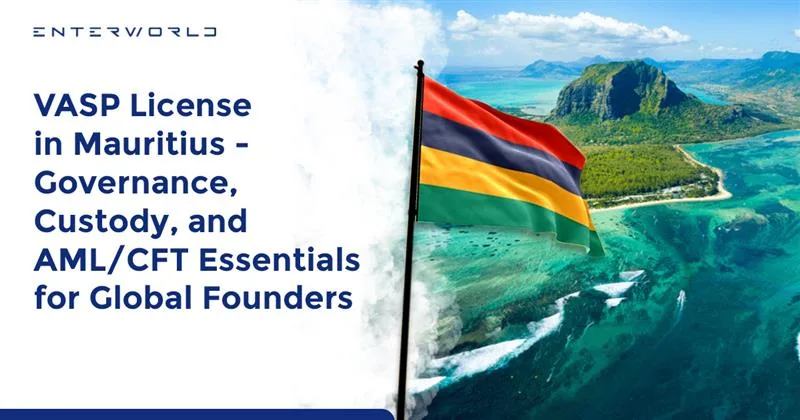
Mauritius is an ideal jurisdiction for crypto business with a regulatory framework that is in line with the FATF VASP requirements. Applying for a Mauritius VASP license has become one of the most attractive crypto business jurisdictions for businesses.
The Financial Services Commission (FSC) of Mauritius has made it clear that it will grant licenses to companies that have proper governance and custody. Many applications are rejected not because of their business model, but because either their governance, key personnel, or custody models have not reached the relevant standards.
Regardless of whether you are just planning on registering a cryptocurrency business in Mauritius or are already at the stage of applying for Mauritius VASP registration, this guide will cover governance, custody, and compliance patterns that will pass regulatory scrutiny, as well as pitfalls to avoid. Post company registration in Mauritius, most global business owners explore major fintech and crypto licenses.
Let’s understand what a Mauritius Virtual Asset Service Provider is
In Mauritius, a Virtual Asset Service Provider (VASP) is any entity that enables the transfer, exchange, protection, or issuance of virtual assets, including cryptocurrencies and digital tokens. The Virtual Asset and Initial Token Offering Services Act (VAITOS Act) regulates all the activities, and this aligns Mauritius with global standards for digital asset regulation in Africa.
The FSC Mauritius has classified VASPs into several categories:
- Exchange/platform operators
- Custody providers
- Broker/OTC desks
- Token issuers
- Portfolio managers
All the above categories have their own distinct capital, licensing, and AML/CFT obligations for virtual asset providers. For instance, custody providers must provide crypto custody architecture, proof of reserves, and separation of assets. Token issuers, on the other hand, have to follow tougher rules around disclosure and governance.
The first step to secure an FSC Mauritius crypto license is when you understand the classification and structuring of a compliant, scalable crypto business in Mauritius.
Also Read : How to Register a Company in Solomon Islands as a Foreigner?
Why Governance & Custody Matter to Regulators?
While licensing Virtual Asset Service Providers (VASPs), Mauritius regulates two primary goals: first, to protect clients’ assets, and second, to ensure financial integrity through AML/CFT compliance. These two goals guide how the Financial Services Commission (FSC) considers applications for a VASP license in Mauritius.
The risk lens of the regulator emphasizes:
- Operational resilience
- Assets segregation
- Duty segregation
- Access controls
- Conflict-of-interest management
- Continuity planning
The most common reasons for license rejection or enforcement are because of governance failures. Additionally, applicants fail to demonstrate the governance framework that guarantees transparency, accountability, and risk mitigation instead of just mentioning technical capability.
VASP Classes & the Regulatory Expectations
Each VASP class in Mauritius has its own individual governance and custody expectations. The first step to form a compliant license application is to identify your VASP class.
Identify your VASP class:
| VASP Class | Governance & Custody Requirements | Regulator Will Ask For |
| Exchange / Trading Platform | Independent custody, client asset segregation, reconciliation, and internal audit | Proof of segregation and audit trail |
| Custodian / Wallet Provider | Multi tier controls, insurance, cold/hot wallet policy, proof of reserves | Third party attest and wallet architecture |
| Broker / Over-The- Counter Desk | Integrated KYC/EDD, monitoring of transactions, and policies for managing conflicts of interest | AML manual and monitoring to ls |
| Issuer / Token Project | Token governance, smart contract audits, treasury custody, and vesting controls | Smart contract audit report and treasury standard operating procedures (SOPs) |
| Portfolio Manager / Fund | Segregation of client funds and trustee arrangements, and fee governance | Trustee arrangement and fee policy |
It is essential to understand your classification, as it is easier to integrate your governance, custody, and
AML/CFT frameworks with Mauritius VASP requirements.
Governance: Board, Policies & People That Pass
Always remember that governance is both documentary (evidence and policies) and structural (board and committees). A clear note of accountability and proof of implementation is expected by the regulators.
Here is a step-by-step description of the governance framework that a VASP in Mauritius must establish to meet regulatory expectations.
Step 1: Board and Senior Management
- Independent board members with financial, tech, and compliance experience.
- Must have defined roles such as CEO, MLRO, CTO, CISO, and Head of Custody.
- Board minutes and conflict-of-interest registers.
Step 2: Committees and Reporting Lines
- Risk, audit, and compliance committees.
- Direct reporting lines from the Money Laundering Reporting Officer/Chief Information Security Officer to the board.
Step 3: Policies and Evidence
- Written policies such as Governance, Risk, InfoSec, Crypto Custody, Business Continuity, Incident Response, and Outsourcing.
- Living behind evidence, such as logs, board packs, internal audits, and third-party reviews.
Step 4: Vendor and Outsourcing Governance
- Custodian due diligence, Service Level Agreements, penetration testing, and sub-custodian oversight.
- Policies that are implemented, not just written; regulators want proof of that.
Technology and Custody Architecture That Regulators Will Accept
Custody is both technical and organizational, whereas regulators consider architecture, controls, and operational resilience.
To know your crypto custody is safe, regulator-ready, and auditable, follow the steps below explaining how to design, secure, and prove:
Step 1: Custody Models
- Full segregation with licensed third-party custodians: preferred for client assets.
- In-house custody: acceptable with strong governance, audits, and insurance.
- Hybrid: cold storage for reserves, along with hot wallets for operations with exposure limits.
Step 2: Key Technical Controls
- Multi-party computation (MPC) or multi-sig.
- Hardware Security Modules (HSMs).
- Separation of signing versus operational authority.
- Tamper-proof audit trails, immutable logs.
- Secure Software Development Life Cycle (SDLC) and smart contract audits.
Step 3: Operational Controls
- Wallet reconciliation, proof-of-reserves, and role-based access.
- Transaction approval workflows and incident playbooks.
- Penetration testing and third-party security assessments.
Step 4: Insurance & Attestations
- Custody versus operational risk coverage.
- SOC 2, ISAE 3402, PCAOB-style attestations.
You must include a custody diagram showing hot/cold wallets, key holders, and third-party custodians.
AML/CFT Expectations: What Passes
Anti-Money Laundering (AML) or Counter Financing of Terrorism (CFT) is a core pass/fail area for Virtual Asset Service Provider (VASP) compliance in Mauritius. Regulators assess systems, culture, and reporting.
Below are the steps explaining how a VASP should detect, prevent, and report financial crime risks while serving regulators so that it functions ethically and transparently.
Step 1: KYC & EDD
- Risk-based KYC tiers.
- Ongoing monitoring process.
- Enhanced Due Diligence (EDD) for Politically Exposed Persons (PEPs) and high-risk jurisdictions.
Step 2: Transaction Monitoring
- Provide real-time alerts.
- Rules for mixing or tumbling and source-of-funds logic.
- Chain analysis tools.
Step 3: Suspicious Transaction Reporting
- Money Laundering Reporting Officer (MLRO) responsibilities.
- Does internal escalation
- Timely reporting to the Financial Intelligence Unit (FIU).
Step 4: Record Keeping & Audit
- Retention policies
- Historical trail production
Step 5: Training & Culture
- Regular staff training.
- Attestations and compliance KPIs.
Do not miss focusing on whether there is weak onboarding, missing transaction monitoring, and incomplete source-of-funds checks.
Reporting, Audit, and Supervisory Expectations
Timely reporting, audit access, and supervisory cooperation are expected by the regulators.
- Proper monthly reconciliations.
- Keep proof-of-reserve reports.
- Incident and AML reports.
- Annual external audits.
Please ensure reputable auditors with experience in event crypto. In case of emergencies, regulators may request cold-wallet access when needed to set up urgency protocols.
Common Pitfalls and How You Can Avoid Them
| Common Pitfalls | Mitigation | |
| 1 | Treating custody as entirely technical | Governance evidence + board oversight |
| 2 | Complete dependency on unaudited reserves | Third-party affirmation |
| 3 | Vague outsourcing contracts | Documented SLAs + audit rights |
| 4 | Poor asset segregation | Wallet architecture + reconciliation logs |
| 5 | No MLRO or escalation path | Appoint an MLRO + define reporting lines. |
| 6 | Missing incident response plans | Draft playbooks + test backups |
Step-by-Step Checklist to Prepare a VASP License Application in Mauritius
To prepare a complaint VASP license application in Mauritius, follow the checklist below:
- Identify your VASP class and map license requirements.
- Appoint board & officers (MLRO, CTO, CISO) with CVs and disclosures.
- Draft core policies: Governance, Custody, InfoSec, AML/CFT, Business Continuity.
- Design custody architecture diagram (hot/cold, key holders, third-party custody).
- Contract with custodians or prepare SOPs with SLAs and audit rights.
- Implement KYC or monitoring tools and draft an AML manual.
- Commission tech audits (e.g., penetration test and smart contract audit) and obtain third-party attestations.
- Prepare reconciliation and reserves procedures with sample reports.
- Run internal dry-run: compile board packs, minutes, evidence binder.
- Engage with local counsel and submit a complete application.
To support your documents, attach files such as CVs, policies, diagrams, audit reports, AML manual, and board minutes.
Conclusion and a Quick Checklist
In order to get a VASP in Mauritius, applicants must have the following:
- A clear governance structure.
- Powerful custody architecture.
- Demonstrable AML/CFT controls.
- Third-party attestations.
- Audited financials.
A Quick Checklist for the VASP License in Mauritius:
- Board & MLRO appointed.
- Custody design diagram.
- AML/CFT program in place.
- Third-party audits & attestations.
- Reconciliation & reporting procedures.
How Enterworld can help with VASP Licensing in Mauritius?
Are you in need of a VASP-ready company structure in Mauritius? Enterworld is a reliable solution for your problem. We help our clients with the company registration, ready to file the license and governance design. Schedule a compliance health check or document review today, and get started with your company registration and VASP licensing.
Top Questions Regarding About VASP Licensing in Mauritius
A Virtual Asset Service Provider (VASP) is any entity that enables the transfer, exchange, protection, or issuance of virtual assets, including cryptocurrencies and digital tokens. The Virtual Asset and Initial Token Offering Services Act (VAITOS Act) regulates all the activities, and this aligns Mauritius with global standards for digital asset regulation in Africa.
The Financial Services Commission (FSC) is the main regulator controlling VASPs in Mauritius. It executes compliance under the VAITOS Act, FSC Rules, and AML/CFT regulations issued by the Financial Intelligence Unit (FIU).
VASPs are normally classified into service categories such as:
Exchange or trading platform
Custodian or wallet provider
Broker or intermediary
Token issuer
Portfolio manager or investment adviser
Each class has different governance, capital, and reporting requirements.
Regulators expect a clear governance framework- including qualified board members, documented roles (CEO, MLRO, CISO), defined reporting lines, independent committees, and written policies covering governance, risk, and information security.
It means showing regulators evidence that policies are followed in practice – e.g., meeting minutes, board packs, audit logs, compliance reviews, and proof of segregation of duties, not just having policies on paper.
Custody ensures client assets are secure and segregated. Regulators look for multi-sig or MPC key management, strong wallet security, insurance, reconciliation processes, and independent custody attestations.
Yes, but only if it demonstrates robust governance and technical safeguards- including segregation of client assets, hot/cold wallet controls, and periodic audits. Many firms prefer licensed third-party custodians for compliance assurance.
VASPs must perform KYC, enhanced due diligence, transaction monitoring, report suspicious activity to the FIU, and maintain detailed records. They must also appoint a Money Laundering Reporting Officer (MLRO).
Most rejections result from weak governance, unclear accountability, missing policies, or inadequate custody arrangements. Applicants often fail to provide evidence that controls are actually implemented.
The licensing process typically takes 3–6 months, depending on the completeness of documentation, background checks, and regulator feedback. Well-prepared applications with clear governance frameworks move faster.
Licensed VASPs must submit periodic reports (financial statements, AML/CFT reports, and incident disclosures) and proof of reserves or reconciliations to the FSC. Annual external audits are usually required.
Yes. Mauritius allows foreign ownership, but the commodity must be locally incorporated and have resident directors and compliance officers. You can learn more about company registration in Mauritius through the official portal.
Key documents include:
Incorporation certificate
Business plan and financial projections
Board and management CVs
Governance and AML/CFT policies
Custody architecture and SOPs
Insurance proof and third-party attestations
Yes. Regulators anticipate a physical presence, local directors, and key control functions (compliance, risk, and audit) to be based in Mauritius. This is purely remote, and “mailbox” setups are not accepted.

Florida LLC for Amazon FBA: Ultimate 2026 Guide...
Mar 16, 2026
How to Register a Company in Dubai Silicon Oasis...
Mar 10, 2026

How to Start Logistics Business in Oman in 2026?...
Mar 03, 2026

How to Start an Interior Design Company in Dubai...
Feb 25, 2026
The Top 8 Benefits of Incorporating a Company in...
Feb 02, 2026
Startup Tax Exemption Singapore 2026: A Complete...
Jan 28, 2026
Australia Corporate Tax & Incentives: Update...
Jan 22, 2026
How to Set Up a Company in the United States: 20...
Jan 22, 2026
Annual Compliance Calendar in Australia 2026: Al...
Jan 21, 2026

Foreign Ownership Rules in the United States: Wh...
Jan 20, 2026