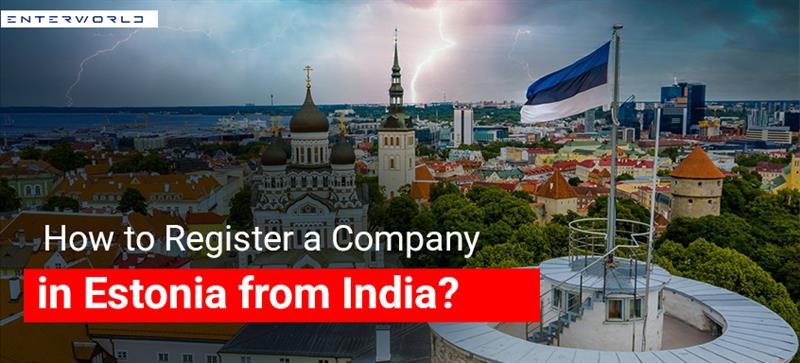
Estonia is a great option if you’re an Indian digital nomad hoping to launch a company with robust government backing and convenient access to the EU. Its well-developed digital infrastructure, business-friendly tax framework, and e-Residency program make it a desirable place to launch a firm. If you register your business, you can take advantage of many benefits, and Enterworld can assist you with the registration procedure.
This blog will provide you with detailed information about starting a business in Estonia as an Indian. Additionally, you will comprehend the necessity of establishing a business in Estonia, the prerequisites, and all the information you require before beginning or growing your enterprise in Estonia.
Why Register a Company in Estonia?
A world leader in digital governance, Estonia provides a simplified, entirely online approach for launching and managing a business from any location. Thousands of entrepreneurs, particularly remote teams, freelancers, and tech startups, choose Estonia for the following reasons: –
- 100% Online Setup: You can use Estonia’s e-Residency program to register, manage, and grow your company remotely.
- EU Market Access: You can establish a legitimate presence in the European Union (EU) without relocating.
- Zero Tax on Retained Earnings: You are exempt from corporate tax until profits are distributed.
- Strategic Location: Estonia has access to both European and Scandinavian markets due to its geographic location.
- Transparent, Pro-Business Policies: Among the world’s most technologically advanced and business-friendly nations.
- Global Credibility: By employing an EU-registered firm, you can win over European partners and clients.
- Prosperous Startup Ecosystem: Skype, Playtech, Wise, and Bolt are just a few of the well-known success stories from Estonia’s booming startup sector.
- Funding and Support: Estonia provides a range of startup funding options and support initiatives.
Business Entities for Company Registration in Estonia
To form a corporation in Estonia, you can choose from a variety of corporate entity kinds, each with unique criteria and peculiarities. Each type of entity has its own advantages and needs. To learn more about the requirements, speak with our team of professionals at Enterworld.
The following are the most popular entity kinds for business registration in Estonia:
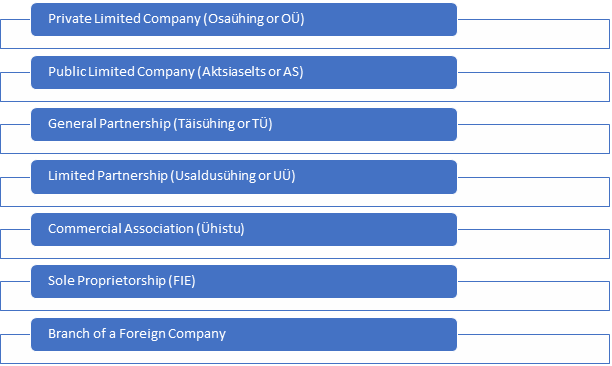
1. Private Limited Company (Osaühing or OÜ)
- Most often used structure for small and medium-sized enterprises and e-residents.
- Requires a minimum of one director and one shareholder, who may be the same individual.
- €0 is the required minimum share capital.
- Liability is restricted to the share capital amount.
- Management is straightforward; no supervisory board is needed.
- Perfect for remote-first businesses, consultants, freelancers, and startups.
2. Public Limited Company (Aktsiaselts or AS)
- Ideal for bigger businesses looking to attract investors or go public.
- Requires a minimum of €25,000 in share capital.
- Both a supervisory board and a management board are required.
- Able to trade on stock exchanges and issue shares.
- More intricate corporate governance and compliance standards.
3. General Partnership (Täisühing or TÜ)
- Composed of two or more partners who are equally liable for the debts of the business.
- No minimum amount of capital is needed.
- Usually, profits and losses are divided in accordance with the agreement.
- Partners have unlimited personal liability.
- Perfect for small companies with high levels of partner trust.
4. Limited Partnership (Usaldusühing or UÜ)
- A minimum of two partners are required to form it: a general partner with unlimited liability and a limited partner with limited financial commitment.
- There is no minimum share capital needed.
- combining the advantages of limited and personal liability.
- Perfect for family enterprises or passive investors.
- Not ideal for distant startups, but more appropriate for conventional collaborations.
5. Commercial Association (Ühistu)
- Members who provide resources or consume its services own the cooperative.
- The goal is not to maximize profits, but to benefit both parties.
- At least two founding members are required.
- Members may be either people or organizations.
- Perfect for: Producer networks, housing cooperatives, and agricultural organizations.
6. Sole Proprietorship (FIE – Füüsilisest Isikust Ettevõtja)
- Company run by a single person rather than a distinct legal body.
- All debts are the owner’s own responsibility.
- The Estonian Tax and Customs Board requires registration.
- It is exclusively available to Estonian citizens and cannot be created using e-Residency.
- Ideal for small business owners, artists, and independent contractors in the area.
7. Branch of a Foreign Company
- A registered extension of a foreign business that already has operations in Estonia.
- Not a distinct legal body.
- It is necessary to register in the Estonian Commercial Register and choose a local contact person.
- For branch operations, the parent business has complete responsibility.
- Perfect for foreign businesses growing their operations in Estonia or the EU.
Eligibility for Company Registration in Estonia
There are prerequisites that must be fulfilled in order to register a business in Estonia. These requirements include:
- The name of the firm must be unique and unclaimed by another entity.
- People must be e-residents or possess a valid ID card or mobile ID from Estonia, Belgium, Latvia, or Lithuania.
- The people who register the business must be private citizens, not corporations.
- A notary visit is required for document verification if the person is not an e-resident or does not have the necessary ID cards.
- To start a business in Estonia, you can apply for a Startup Visa, which is valid for up to 18 months.
- It is necessary to have a legal address in Estonia, which may be a virtual office.
- Although payment might be postponed, a minimum share capital is necessary.
- Before registering, the articles of association must be written and notarized.
- The share capital must be deposited into a business bank account.
- An activity license is required if the company is subject to special regulations.
What is e-Residency and Why Is It Required?
E-Residency, in particular Estonia’s scheme, is a government-issued digital identity that enables non-Estonians to establish and run a wholly online business in the EU. It does not confer the right to live or work in Estonia because it is not physical residency. Rather, it offers an electronic ID card that allows:
- Create and run a business entirely online.
- Get access to EU business taxation, accounting, and banking resources.
- Run the business remotely and digitally sign the documents.
Procedure for Company Registration in Estonia from India
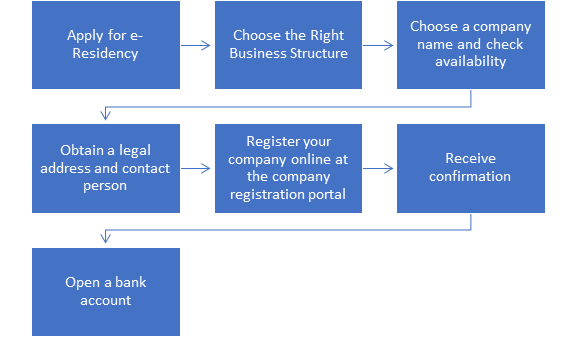
1. Apply for e-Residency
Your digital entryway to remotely registering and running a business in Estonia is Estonia’s e-Residency scheme. You must apply for this before beginning the company registration process if you are an Indian citizen.
What you must do to obtain e-Residency:
- Go to the https://www.e-resident.gov.ee/ site.
- Complete the online form.
- Upload a passport-sized photo and a passport scan.
- Write a succinct statement of purpose.
- Pay the €100 – €120 government charge.
- Select an Indian location (Delhi, Mumbai, Bangalore, etc.) to pick up your e-Residency card.
2. Choose the Right Business Structure
Although Estonia has a variety of legal entity forms, the Private Limited Company (OÜ) is the most advised for Indian e-residents due to the following reasons:
- It permits foreign ownership at 100%.
- Only one founder or director is needed.
- Deferring share capital allows you to begin with €0.
- Your share capital is the limit of your liability.
Public limited companies (AS), limited partnerships (UÜ), and general partnerships (TÜ) are additional choices, but they are less appropriate for small distant founders.
3. Choose a Company Name and Check Availability
Prior to registration, you will need to select a distinctive business name.
How to look up availability:
- Visit the Business Register of Estonia.
- Make use of the firm name search function.
- Verify that the name doesn’t sound too similar to that of other companies.
- A Private Limited Company’s name should normally conclude with “OÜ.”
If you’re not sure, you can reserve a name through your service provider.
4. Obtain a Legal Address and Contact Person in Estonia
As an Indian non-resident, Estonian law requires you to have:
- An official business registration address that is located within Estonia
- A specific point of contact who can accept formal legal paperwork on your business’s behalf.
You must partner with a licensed Estonian service provider like Enterworld, which offers these services.
5. Register Your Company Online at the Company Registration Portal
You can use the Estonian Business Register Portal to register your business after setting up your e-Residency card and service provider:
What you’re going to do:
- Use your digital ID card to log in.
- Enter the company’s name, board members, and activities.
- Your service provider will assist you in uploading the articles of association.
- Pay the €265 state charge.
- Send in the application to be reviewed.
6. Receive Confirmation
After being accepted, you will get:
- Company registration number
- Official digital confirmation
- Access to the e-Business account of your business
It is now lawful for you to run your Estonian company from India or any other location.
7. Open a Business Bank Account
- To send and receive money after registering, you must have a business account.
- Since it typically takes an in-person visit to open a standard Estonian bank account, the majority of Indian founders choose fintechs based in the EU, like Astute Business, The Payoneer and Revolut Enterprise.
Documents Required for Company Registration in Estonia
To register your Estonian corporation (OÜ), you will need the following documents:
- E-Residency card: This is necessary in order to register online. You will need a copy of your valid Indian passport, a passport-size photo, a motivation statement, and an application fee (€100–120) in order to generate an E-Residency card.
- Articles of Association: A statement of the organization’s composition and functions.
- Founders’ and Management Board members’ data: Including personal identification and contact information.
- Verification of the legal address: Evidence of an Estonian registered office.
- Consent of the contact person (where applicable): Consent from the contact person is required if they are used.
What are your Tax and VAT Responsibilities as an Estonian Business Owner?
You will be required to pay business taxes because Estonia is not a tax shelter. However, its tax laws are simple and fair, so maintaining records isn’t a hassle.
Corporate tax
The 20% business tax rate in Estonia only applies to profits that are taken out of the business. You won’t be required to pay any taxes for your retained earnings.
VAT (Value-Added Tax)
You should register for VAT, if your yearly revenue surpasses €40,000 or if you offer digital products or services to clients in the EU.
Rate of VAT:
- Typical: 20%
- Decreased: 9% or 0% (for exports and books, for example).
Social tax
- Like social security in the US, Estonia levies a 33% social tax. You must pay this tax if you are a private limited company director or a lone owner.
- However, Estonia has social security agreements with several nations, such as Ukraine, Canada, and the United States. You can avoid paying social taxes in Estonia if you already pay them in your home country by completing an A1 form and stating that you do so there.
How Much does it Cost to Open a Business in Estonia?
Which kind of business you open will determine this. As the most common business structure, a private limited company (OU) will cost about, which includes:
- For e-residency, EUR 120
- The company registration fee is EUR 265.
- A legitimate physical location and local contact person costs between EUR 30 and EUR 150 per month.
To Wrap Up
By providing a completely digital, borderless company registration system through its e-Residency program, Estonia has completely changed the way the world views business. This offers Indian business owners a rare chance to launch a reputable EU-based enterprise, reach clients throughout the world, and work from home without having to move or deal with complicated local red tape.
You can lawfully operate an international business from India by following a straightforward procedure that includes filing for e-Residency, registering your Private Limited Company (OÜ), creating a virtual address, and handling taxes. With cheap operating costs, worldwide access, and no retained earnings tax.
In the end, the process of registering a business in Estonia may be costly and time-consuming. Hiring an Enterworld expert to help you with the company registration process in Estonia is advised.
FAQs About Register a Company in Estonia
No, e-Residency is not the same as citizenship or a visa. The right to live, work, or enter Estonia or the EU is not conferred by this digital identity, which enables people to access and run a business online in Estonia.
No, you do not have to travel to Estonia in order to start a business there. With e-Residency, you can conduct business online without physically being in Estonia and create and run an Estonian firm from a distance.
In Estonia, registering a business can be completed quickly, especially if you use the e-Residency program. When registering online using the e-Business Register, the process typically takes one to three working days.
Yes, 100% foreign ownership of businesses is permitted in Estonia.
There are many advantages to starting a business in Estonia, including the following: –
A favourable tax system
Access to the EU market
A digital-first environment
Supportive startup ecosystem
100% foreign ownership
During the application process, you can select from pickup places such as Bangalore, Mumbai, or New Delhi.
Yes, Estonia requires businesses to have a local legal address and a point of contact, particularly if the management board is based outside the country. The Commercial Code specifies this condition.
Indeed. Foreign ownership and income must be reported on Schedule FA of your Indian ITR (Income Tax Return). In India, these types of incomes fall under the category of “Other Income” taxation.
In Estonia, a private limited corporation (OÜ) must have a minimum of €2,500 in share capital. It’s crucial to remember that although the minimum is €2,500, payment can be postponed; at least €1 must be paid at registration. After registering, you have ten years to pay the remaining balance.
Yes! Live assistance is included of your plan. You can use our website’s chatbot to start a conversation with us at any moment. As an alternative, you can contact us via our customer service hotline or email. Your specialized Customer Success Manager will automatically answer your call and be ready to assist you. Our team usually responds within a few hours when it’s not within regular business hours.

Florida LLC for Amazon FBA: Ultimate 2026 Guide...
Mar 16, 2026

How to Register a Company in Dubai Silicon Oasis...
Mar 10, 2026

How to Start Logistics Business in Oman in 2026?...
Mar 03, 2026

How to Start an Interior Design Company in Dubai...
Feb 25, 2026

The Top 8 Benefits of Incorporating a Company in...
Feb 02, 2026
Startup Tax Exemption Singapore 2026: A Complete...
Jan 28, 2026

Australia Corporate Tax & Incentives: Update...
Jan 22, 2026

How to Set Up a Company in the United States: 20...
Jan 22, 2026

Annual Compliance Calendar in Australia 2026: Al...
Jan 21, 2026

Foreign Ownership Rules in the United States: Wh...
Jan 20, 2026