Introduction
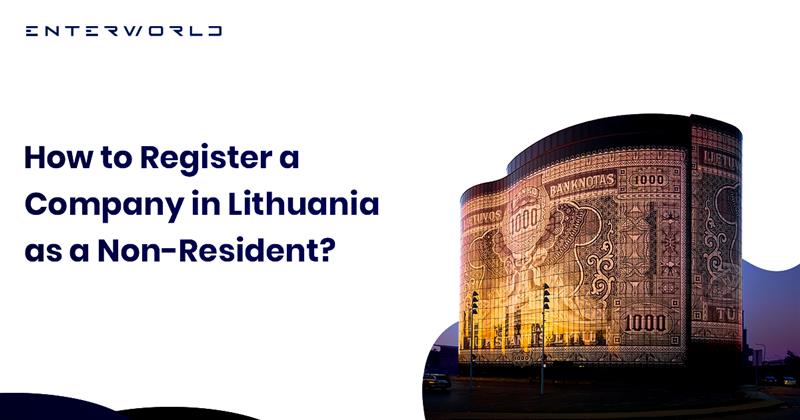
Lithuania is a small country in Northeastern Europe, one of the three Baltic states, bordered by Latvia, Belarus, Poland, and Russia. Lithuania is a developed country with an advanced economy and a high income.
In 2025, Lithuania offers a strong and growing economy, with a steady GDP growth and increasing opportunities across various sectors, showing a promising future for businesses. The country is known for its modern business environment, with key industries like Information and Communications Technology (ICT), fintech and global business services. Additionally, Lithuania has one of the lowest corporate taxes in Europe with attractive incentives for research-based innovations and companies established in the country’s Free Economic Zone.
The government is also making it easy for foreign entrepreneurs to enter Lithuania’s market by simplifying the process through its online portal. This blog will help you understand and navigate how to register a company in Lithuania as a non-resident and leverage the exciting opportunities the country offers its foreign entrepreneurs.
Why Lithuania?
Lithuania because:
- Seamless access to Europe’s single market
- Low corporate income tax of 7% and 16%
- Enjoy Double Taxation Treaty (DTT) protection
- Stable and secure economy
- One of the most advanced e-governments in Europe
Regulatory Authority for Company Registration in Lithuania
The regulatory authority responsible for company registration in Lithuania is the State Enterprise Centre of Registers (Registrų centras). This authority maintains the legal data of the country and the data from the register of legal entities. The authority provides services related to company registration and is also responsible for registering new companies.
Visa Requirements for Non-Residents
As a non-resident in Lithuania looking to do business in the country, you will have to apply for the right visa. The most appropriate visa for non-resident entrepreneurs is the National Visa, which is a D-Type Visa to conduct business activities in the country.
However, to be eligible for this business visa, you will have to fulfil certain criteria’s and show proof of sufficient funds to sustain yourself and the business, have a detailed business plan and ensure you don’t have any criminal record. You can also apply for a Startup Visa or a Business Immigration Visa, provided you qualify and get approval from an expert panel for the business idea.
How to Register a Company in Lithuania?
Company registration in Lithuania can be done online either through Lithuania’s eGovernment platform or offline at a local Centre of Registers office.
To register a company in Lithuania as a non-resident, you will need to follow the following
steps:
- Decide the Type of Business and the Company Structure
The first step to register a company in Lithuania as a non-resident is to decide the type of business you wish to start in the country. You should also conduct market research to understand your target customers and the scalability of your business idea. Depending on your business type, you will need to select the company structure that meets your business needs.
- Apply for Business Visa
As a non-resident entrepreneur in the country, you will need a business visa to enter the Lithuanian market. Apply for the right business visa after checking the eligibility, and submit the visa application with supporting documents. Determine the right type of business visa, such as a Schengen Business Visa or a National Visa.
- Register a Legal Address
It is mandatory for non-resident entrepreneurs looking to start a business in Lithuania to have a legal address before registering the company. The legal address can also be a virtual office address provided by a third-party service provider; this is especially convenient for non-resident entrepreneurs who wish to operate the business from their place of residency. This registered address will show as your legal address in the Commercial Register.
- Reserve the Company Name
To register a company, you will need to reserve a company name under the guidelines set by the Lithuanian Company Register. The name selected should be unique and must not be used by any other business in the country. You can check and verify the availability of the company name from the online tool of the State Enterprise Centre of the Register.
- Prepare the Mandatory Documents
To register your company, you will need to prepare and submit the mandatory documents along with the application. You will have to prepare mandatory documents like Articles of Association (AoA), identity proofs, proof of registered address, confirmation of minimum share capital deposit and company name reservation certificate, etc.
- Open a Corporate Bank Account
The company will also have to open a corporate bank account to deposit the minimum share capital requirement. The minimum capital is different for each company structure. If your business deals with international and foreign transactions, choose a bank that offers multi-currency accounts. You can also look for a bank that offers services such as payroll or integration with accounting software.
- Register with the Register of Legal Entities
As a non-resident entrepreneur, to legally operate a business in Lithuania, you will have to apply for business registration with the Register of Legal Entities. With the application, you will have to submit the supporting documents requested by the authority and pay the fees. Once verified and approved, the Register of Legal Entities will provide the certificate of incorporation.
- Register for Value Added Tax (VAT)
After your company has been established and you have received the certificate of incorporation, it is mandatory for non-resident entrepreneurs to enrol for VAT with the State Tax Inspectorate through their online (VMI) portal. However, before VAT registration, non-resident companies will have to register with the taxpayer’s register.
Structures for Company Registration in Lithuania
Lithuania offers various structures for company registration. These structures are customised depending on the business needs and business type. When you choose the right structure, you can leverage the benefits each structure offers for the business. The different types of structures for company registration in Lithuania are:
- Public Limited Company (AB)
A public limited company in Lithuania, locally known as Akcinė Bendrovė (AB), is one of the company structures for incorporation. This structure is commonly preferred by most local and non-resident entrepreneurs for both small and medium-sized enterprises (SMEs) and big corporations. You will need a minimum capital of €40,000 and a minimum of one shareholder for incorporation, and enjoy limited liability.
- Private Limited Company (UAB)
A private limited company, locally known as Uždaroji Akcinė Bendrovė (UAB), is a structure popularly used for small businesses. For a private limited company in Lithuania, you will need a minimum capital of €2,500 for incorporation, and you will not be allowed to have more than 250 shareholders. Additionally, you will enjoy limited liability, and your assets will be protected from company loss or debts.
- Partnership (General partnership, i.e., TUB and Limited partnership, i.e., KUB)
Partnership structures in Lithuania are of two types:
- General Partnership (TUB)
The general partnership, locally known as Tikroji ùkine bendrija (TUB), is a partnership where all the partners are equally and personally liable for the company responsibilities and liabilities. In a general partnership, the liabilities are unlimited.
- Limited Partnership (KUB)
The limited partnership in Lithuania, locally known as Komanditiné ùkiné bendrija (KUB), is a company structure that involves both general and limited partners. The owners in the company with management rights and liabilities are known as general partners, and the ones with restricted authority, liability and responsibility are referred to as limited partners.
- Representative Office
A representative office is a structure customised for the non-resident entrepreneurs in Lithuania, it is an extension of the foreign company in the country that is used for research, marketing and promoting the services or products of the parent company. However, as a non-resident, if you register a representative office, you will not be allowed to conduct commercial activities to generate profit with this company structure.
- Branch Office
A branch office is also a company structure customised for the non-resident entrepreneurs in the country; however, unlike the representative office, you will be allowed to conduct business activities in the country to generate profit. The branch office will be an expansion of your business operations under the guidelines of the parent company, and all the debts and liabilities will be the responsibility of the parent company.
Investment Opportunities and Support
Lithuania offers attractive investment opportunities across a variety of sectors. Its business-friendly policies and government incentives have attracted various global companies. To support foreign investors, the government’s investment promotion agency “Invest Lithuania” provides useful information to potential investors, guidance and valuable support.
By partnering with Invest Lithuania as a non-resident entrepreneur, you will gain a competitive advantage and can connect with a wide network of local resources.
Benefits of Starting a Company in Lithuania
The benefits of starting a company in Lithuania are:
- Lithuania has a pro-business environment with an open economy and excellent business-friendly policies for both domestic and global entrepreneurs.
- The country has one of the most advanced e-governments in Europe, simplifying company registration at every stage.
- It has one of the lowest corporate tax rates in Europe, which benefits all businesses.
- Lithuania has a strategic location, allowing easy access to Europe’s single market.
- The country offers a cost-effective and tech-friendly environment with strong support from the government for innovation and technology.
- Lithuania has a growing number of startups and entrepreneurs, as the country is supporting the startup ecosystem through business incubators.
Taxation Structure in Lithuania from 2025
The different tax rates for companies to pay in Lithuania include:
- The standard corporate income tax rate in Lithuania is 16% (implemented in January 2025).
- Tax rate for small businesses is 7% (if your company has less than 10 employees and the annual revenue is less than €300,000).
- Qualifying startups can enjoy 0% corporate income tax for two years.
- Dividends are subject to a flat tax rate of 16%.
- The standard value-added tax rate in Lithuania is 21%, specific products and services are eligible for 12% and 5%.
- Personal income tax has two taxation brackets, 20% for an annual income under €126,532 and 32% for income above €126,532.
- The personal income tax has a flat rate of 15% for dividends in income from profit distribution.
- Real Estate tax rate, which is the property’s taxable value, has an annual tax rate ranging from 0.5% to 3%.
Cost of Company Registration in Lithuania
The cost of company registration in Lithuania will include different factors and will depend on the type of structure you choose, whether you choose a public limited liability company (AB), or a branch office, your company type, charges for opening a bank account and registering a physical office address, etc.
The various costs to consider for company registration in Lithuania include:
- Company registration in person will be around €500
- Company registration remotely through an agent or by power of attorney will be €800
- Company share capital for Private Limited Liability Company (UAB) is a minimum of €2,500
- The state online registration fee is around €57.72
- Company name reservation will cost around €21.98
- Notarization of founding documents will be around €70 to €290
- Physical address registration or virtual office registration for non-residents is around €100 to €300 annually.
- Translation of documents to Lithuanian through certified translators will be around €290
Conclusion
Setting up a company in Lithuania offers attractive opportunities for non-resident entrepreneurs looking to enter the European market. The country has low corporate tax rates, a thriving FinTech sector and investor-friendly policies, making Lithuania a top business destination for global entrepreneurs. Whether you are a startup or an established entrepreneur, Lithuania offers a cost-effective gateway and excellent business incentives for you.
However, if you are confused about navigating the business landscape of Lithuania, Enterworld will offer a wide range of services from company name reservation to complete business set up, including the mandatory post-registration requirements. As a global business consultant, our expert professionals will guide you to navigate the complexities of registering your company in Lithuania as a non-resident.
Contact us today to speak with our experts or visit our website to learn more: visit https://enterworld.io/.
Frequently Asked Questions About Register a Company in Lithuania
Yes, non-residents can start a company in Lithuania without the need for a local partner; however, it is mandatory to have a registered office address within the country. You can also enjoy 100% foreign ownership and register your company at the comfort of your home country without having to travel to Lithuania by using a Power of Attorney.
The different types of legal entities available for company incorporation in Lithuania are:
– Private Limited Liability Company (UAB)
– Public Limited Liability Company (AB)
– Partnership (General partnership, i.e., TUB and Limited partnership, i.e., KUB)
– Representative Office
– Branch Office
Yes, as a non-resident in Lithuania, you can own a company. As a non-resident, you will enjoy 100% foreign ownership as the country does not have any residency restrictions for company shareholders or founders, irrespective of nationality. You can also register remotely without having to travel to the country.
Yes, Lithuania is a good place to start a business, the country has a stable economy, the right to a residence permit for non-residents and has one of the lowest corporate tax rates in Europe. Over the years, Lithuania has become an attractive destination for entrepreneurs and investors looking to register a company in the country. It also has pro-business policies and an ease of doing business for both established companies and startups.
Yes, Lithuania have tax on foreign income. However, it is only for taxed residents, but not for the foreign income of non-residents. However, the rules and the tax rates on foreign income are dependent on your residency status and the Double Taxation Treaty (DTT) of the country where the income is earned.
The cost to start a company in Lithuania will depend on the business type and the structure you choose for incorporation. As a non-resident looking to start a company in Lithuania, you can also register remotely, which will reduce the cost of travelling to the country for company registration.
The cost for company registration will involve notarization of founding documents will be between €70 to €290. For in-person registration, the charge is around €500, and for company registration by a power of attorney, it will cost around €800.
The benefits of starting a company in Lithuania as a non-resident are that the country offers a favourable business climate with the lowest corporate tax rates in Europe. The country’s registration process is also simplified through Lithuania’s efficient online processes. Additionally, companies established in Lithuania have access to the European Union’s single market and its strong digital infrastructure.
The standard corporate income tax rate in Lithuania is 16% which was implemented in January 2025; earlier, the corporate income tax was 15%. Companies with fewer than 10 employees and an annual income under €300,000 have a tax rate of 7%.
The tax incentives for companies in Lithuania are:
– Tax incentives to promote research and development and innovations, such as deductions for expenses in R&D and tax credits for the commercialisation of inventions.
– Tax incentives for companies established in the Free Economic Zone include reduced corporate income tax and social security contributions.
The time required to register a company in Lithuania as a non-resident is between 5 and 7 Days. It can also take between 3 and 5 days for remote company registration, provided all the documents are accurate. However, additional time will be required for opening a corporate bank account.

Florida LLC for Amazon FBA: Ultimate 2026 Guide...
Mar 16, 2026

How to Register a Company in Dubai Silicon Oasis...
Mar 10, 2026

How to Start Logistics Business in Oman in 2026?...
Mar 03, 2026

How to Start an Interior Design Company in Dubai...
Feb 25, 2026

The Top 8 Benefits of Incorporating a Company in...
Feb 02, 2026
Startup Tax Exemption Singapore 2026: A Complete...
Jan 28, 2026

Australia Corporate Tax & Incentives: Update...
Jan 22, 2026

How to Set Up a Company in the United States: 20...
Jan 22, 2026

Annual Compliance Calendar in Australia 2026: Al...
Jan 21, 2026

Foreign Ownership Rules in the United States: Wh...
Jan 20, 2026
Get free tips and resources right in your inbox, along with 10,000+ others