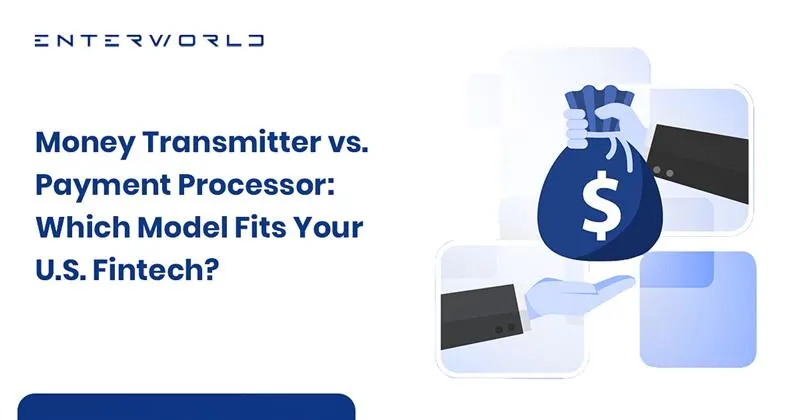
Imagine that you have a great fintech idea, have secured some seed money, and are prepared to go live. Then someone mentions the words “money transmitter license,” and your stomach drops. Suddenly, you’re looking at a year-long licensing process, half a million in legal fees, and fifty different state regulators all asking for different things. Or maybe you don’t need all that or maybe you’re a payment processor and the rules are lighter. But how do you even know which one you are?
We have been in the fintech space long enough to see founders make this call wrong-some overbuilding compliance infrastructure they don’t need, others launching without the licenses they absolutely do need, and getting slapped with cease-and-desist orders. So, let’s break down the difference between a money transmitter and a payment processor, when you need a money transmitter license in the USA, what payment processor registration actually looks like, and how to manage US fintech compliance without losing your mind or your budget. Before opting for the ideal fintech license, company registration in USA is the primary thing.
Why This Matters More Than You Think?
The distinction between money transmitters and payment processors isn’t some legal technicality you can sort out later. It shapes your entire business. Your budget, your schedule, your collaborations, and even your product roadmap. If you do it incorrectly, you’re either operating illegally without realizing it or drowning in needless compliance costs.
Money transmitters basically transfer funds between different individuals. Peer-to-peer transfers, digital wallets, cryptocurrency exchanges, and remittances are all examples of money being transmitted. You are most likely a money transmitter if you are holding client funds or sending them on someone else’s behalf. That means you need a money transmitter license USA in nearly every state where you operate, plus federal registration with FinCEN.
While, payment processors are different, they facilitate transactions between merchants and customers-think Stripe or Square. They’re the middleman making sure your credit card payment gets from your bank to the business you’re buying from. The compliance burden is lighter, but the business model is totally different.
Understanding which bucket you fall into is step one of your U.S. fintech compliance journey.
Read More : The Complete Guide to Starting a Crypto Company in the United States
What Actually Makes You a Money Transmitter?
Let’s start with the formal definition. FinCEN defines a money transmitter as someone who receives money, funds, or value that can be used in place of money from one individual and transfers it to another location or individual using any method. Here’s the straightforward explanation: if you’re transferring money for others, you’re most likely a money transmitter.
Examples from the Real World
You know you’re a money transmitter if you’re running:
- A service to transfer funds to different countries (For example, someone can send funds to their relatives through your service)
- A mobile app to make online payments such as Venmo and Cash App, or Gpay and PayTM in India
- A crypto trading platform (buying, selling, or holding crypto for customers, same as stock exchanges such as Binance)
- A digital wallet (storing funds that users can spend later)
- Check cashing or money order services
If your platform holds customer funds-even temporarily and moves money on behalf of someone else, you will certainly need to meet the money transmitter license USA requirements.
Federal Registration: The First Hurdle
Money transmitters register as Money Services Businesses (MSBs) with FinCEN at the federal level. Within 180 days of beginning business, you submit FinCEN Form 107.
The fact that everyone overlooks is that a FinCEN registration does not equate to a license. It isn’t authorization to work. It is merely a requirement for federal record-keeping. At the state level, where actual licensing takes place, things become more costly and intricate.
Learn More : 100 Profitable Business Ideas in Cyprus
State Licensing: The Real Beast
Every state except Montana requires its own money transmitter license USA for businesses operating there. That amounts to 49 distinct applications, 49 distinct rule sets, and 49 distinct fees.
Furthermore, you cannot simply choose one state and declare it to be good. You must have licenses in California, New York, and Texas if you have clients in those states. For a period.
What Each State Wants?
The requirements may vary, but here’s what you’ll typically face as a money transmitter in any part of the USA:
- The Nationwide Multistate Licensing System is used by the majority of states to centralize applications; however, some states, such as Florida, New Jersey, and the Virgin Islands, continue to handle their own applications.
- Surety bonds are required in every state. Depending on the volume of your transactions, budget $25,000 at the low end and $500,000 to $1 million at the high end.
- Requirements for net worth: You must demonstrate your ability to make ends meet. $100,000 to $500,000, and occasionally more, are typical minimum for such service providers.
- Background checks: Owners, executives, and important staff members’ fingerprints and criminal histories.
- AML program: A thorough compliance program with policies, procedures, training, and oversight for the Anti-Money Laundering and Bank Secrecy Act.
- Audited financials: Evidence of your company’s sound management and financial stability.
- A business plan: This outlines your operations, risk management strategy, and compliance measures.
The Real Cost and Timeline
Let me be blunt: obtaining a money transmitter license USA across multiple states can cost $500,000 to $2 million when you factor in legal fees, compliance staff, surety bonds, application fees, and ongoing operational costs.
Timeline? Six to eighteen months per state, depending on how organized you are and how fast the state moves. Some states (looking at you, New York) are notoriously slow.
This is why so many fintech startups either:
- Launch in just a handful of key states first
- Partner with an already-licensed entity (called a “sponsor bank” model)
- Pivot their business model to avoid being a money transmitter entirely.
U.S fintech compliance for money transmitters is no joke.
What Actually Makes You a Payment Processor?
Payment processors are the other side of the coin. They facilitate merchant transactions-moving money from customers to businesses as part of a sale.
How It Works
Here’s the typical flow:
- Customer enters their credit card info on a merchant’s website, and the payment gateway (often bundled with the processor) encrypts and sends the data.
- Payment processor talks to the card network (Visa, Mastercard, etc.)
- Card network checks with the customer’s bank to verify funds and approve the transaction.
- Approval or decline message comes back through the same chain to the merchant
- If approved, funds settle from the customer’s bank to the merchant’s account (usually 1-3 days later)
The Key Difference
Payment processors don’t hold funds the way money transmitters do. They facilitate transactions between two parties, not accepting and transmitting money on someone’s behalf. That’s the technical distinction that determines whether you need a money transmitter license USA or can operate under lighter payment processor registration rules. But if your payment processing model involves holding merchant funds for an extended period, or if you’re doing something that looks like money transmission (like disbursing to sub merchants), you might still need state licenses.
Payment Processor Registration and Compliance
Just because you’re not a money transmitter doesn’t mean you’re regulation-free. Payment processors face their own U.S. fintech compliance requirements.
PCI-DSS: The Big One
Payment Card Industry Data Security Standard (PCI-DSS) is mandatory if you’re touching credit card data. It’s a set of security requirements designed to protect cardholder information.
Compliance involves:
- Secure network architecture
- Data encryption
- Access controls
- Regular security testing and vulnerability scans
- Incident response plans
Getting PCI-DSS certified can cost anywhere from $20,000 to $200,00,0, depending on your infrastructure and which level of compliance you need.
Card Network Rules
To process Visa, Mastercard, American Express, or Discover payments, you need relationships with those networks. Most startups don’t go direct-they partner with an existing processor or payment facilitator who already has those relationships.
Direct registration with card networks is expensive and complex. Think multi-million-dollar bonds and strict operational requirements.
When Payment Processing Triggers Money Transmission Laws!
Here’s where it gets tricky. Some states-especially California, New York, and Texas-have broad definitions of money transmission that can catch certain payment processing activities.
If you’re holding merchant funds for more than a brief settlement period, or if you’re acting as a payment facilitator distributing funds to sub merchants, you may need a money transmitter license USA in certain states.
This is a grey area. We have seen payment processors confidently launch, only to get letters from state regulators saying, “actually, you need a license here.” Always get a legal opinion specific to your model.
What You’ll Need for Payment Processor Registration?
When you’re setting up as a payment processor or applying to partner with one, expect to provide:
- Business formation documents (LLC or corporation)
- EIN confirmation
- Business bank account details
- Owner identification (passport, driver’s license)
- Business website and terms of service
- Description of your business model and transaction types
- AML and KYC policies (even if not strictly required, good practice)
- Processing history (if available)
Building Your U.S. Fintech Compliance Strategy
Look, compliance isn’t something you set up once and forget about. It’s part of your daily operations, whether you like it or not. And if you’re hoping to wing it, given below is the way out:
Map Out What You Actually Need
Start by figuring out exactly what regulations apply to your business. Don’t guess. Don’t assume. Sit down with someone who knows this stuff and make a list.
Here’s what to look at:
At the federal level, if you’re moving money for people, you’re registering with FinCEN as a Money Services Business. That means filing Form 107 and setting up an Anti-Money Laundering program. You’ll also need procedures for filing Suspicious Activity Reports when something looks off.
For state requirements, figure out which states need you to have a money transmitter license USA. It depends on where your customers are, not where you incorporated. Each state has its own application, its own bond requirements, its own timeline.
If you’re processing payments, PCI-DSS is non-negotiable. Card networks have their own rulebooks too, and they’re not optional.
Privacy laws are everywhere now such as California has CCPA. If you’re dealing with European customers, GDPR applies and other states are passing their own versions, so check what’s live and what’s coming.
Once you’ve got this mapped, build a realistic timeline and budget. We’ve watched too many founders run out of cash halfway through because they thought licensing would cost $50k and take three months. Try $500k and a year. Plan for the real numbers.
Get a Fintech Lawyer Who Knows This Space
You need legal help, not a generalist, not your buddy who does corporate law. Someone who works with fintechs every day and knows the regulators personally.
A good fintech attorney will:
- Tell you straight up if you need a money transmitter license USA or if you can get away with a lighter payment processor registration.
- Walk you through state-by-state differences (and trust me, they’re significant)
- Write your terms of service and privacy policies so they actually comply
- Handle inquiries when regulators come asking questions
- Help you structure things so you’re not boxing yourself in as you scale
Budget $50k to $100k per year minimum. More if you’re licensing in a bunch of states. We know it sounds like a lot, but compare that to what happens when you get it wrong.
Don’t outsource your thinking to lawyers, though. They are going to list every possible threat and paint an adverse picture. You have to base your choices on your awareness of the odds of different outcomes. Find out from them how frequently this really occurs. What does the worst scenario entail? How do we fix it if it goes wrong?
Build Your AML and KYC Systems
Even if you’re not technically required to have formal Anti-Money Laundering and Know Your Customer programs, build them anyway. They create a safer reputation and make you reliable in other businesses’ eyes.
This is what you require:
- Customer verification: Check addresses, collect identification, and monitor platform users.
- Monitoring transactions: Set up alerts for odd patterns or high-risk transactions.
- Don’t wait for authorities to inform you that someone has been using your system to launder money for six months.
- Risk assessment: Not every client poses the same risk. Determine who requires more attention, then take action.
- SAR procedures: Reporting suspicious activity to FinCEN requires a well-defined process.
- Education of employees: Your employees must know what to look for and how to deal with it.
- Routine audits: Bring in a third party to review your work on a regular basis.
Think About Partnering Instead of Licensing
A lot of fintechs skip the whole money transmitter license USA process by partnering with someone who already has licenses. It’s called the sponsor bank model or program manager model.
You build the product and the customer experience. Your partner handles the regulated stuff. You give up some control and share revenue, but you can launch in months instead of years.
For early-stage companies without millions in the bank, this makes sense. You can always get your own licenses later once you’ve proven the business works and raised more money.
Pick Your States Carefully
If you do decide to pursue your own money transmitter license USA in multiple states, don’t try to do all 50 at once. Be strategic about it.
Start with states where you have the most customers or where you’re planning to focus. Add California, New York, and Texas early if you want to be taken seriously by investors and partners, even though they’re expensive and slow.
Use the NMLS system where you can. It doesn’t make things fast, but it’s better than dealing with 50 completely separate processes.
And budget for the ongoing costs, not just the upfront stuff. Annual renewals, audits, compliance staff salaries. They add up.
Some founders launch state by state, going live as each license comes through instead of waiting for all of them. That way you’re generating revenue while the rest of your applications are still pending.
Real-World Scenarios
Let us walk you through three common setups and what compliance actually looks like for each.
Peer-to-Peer Payment App
Say you’re building an app where people send money to friends. Users can keep balances in their wallets until they want to cash out.
You’re a money transmitter. No way around it you’re taking money from one person and sending it to another, plus holding their funds. That means FinCEN registration and state licenses everywhere you operate.
Budget at least a million dollars and 12 to 18 months if you’re going the licensing route or find a sponsor bank and launch way faster while they handle the regulatory side.
E-Commerce Payment Gateway
If you’re building something that lets online stores, accept credit cards. Money flows from customer to merchant through your system, settling in a couple days.
If you’re a payment processor, focus on payment processor registration, PCI-DSS certification, and getting approved by the card networks.
You probably don’t need a money transmitter license USA, but check with your lawyer because some states get picky about payment facilitators. Budget $50k to $200k and three to six months.
Cryptocurrency Exchange
If you’re launching a platform for buying, selling, and holding Bitcoin and other crypto, you’re a money transmitter under federal law and most state laws. FinCEN registration, solid AML and KYC programs, and state licenses. Crypto gets extra scrutiny from regulators, so timelines are longer and costs are higher.
A lot of crypto startups partner with licensed custodians or exchanges instead of getting their own licenses. New York’s BitLicense is particularly brutal if you need to operate there.
Mistakes We Have Seen Founders Make
Some of the list of mistakes we have seen founders make are as mention below:
“We Don’t Hold Funds, So We’re Fine”
This is the most common mistake. State definitions of money transmission are broader than you think. Even brief custody or control of funds can trigger licensing requirements. Don’t assume. Get a legal opinion before you launch.
Underestimating Time and Money
Founders think $100k and three months. Reality is $500k and a year or more. If you budget wrong, you’ll burn through your runway before you’re even licensed.
Launching in Beta Without Licenses
Some companies soft-launch, hoping regulators won’t notice. They do and when they catch you operating without licenses, they can shut you down, fine you heavily, or go after you criminally. Not worth it.
Assuming All States Are the Same
Delaware rules don’t work in California. Texas is different from New York. Every state has its own requirements. Check each one individually.
Cutting Corners on Compliance
When money gets tight, compliance looks like an easy place to save. Founders reduce their AML programs, skip security upgrades, or let documentation slip.
Bad idea. Regulators find the gaps eventually, and the fines hurt. Block Inc. got hit with $80 million in January 2025 for weak money laundering controls. If it can happen to them, it can happen to you.
Moving Forward in U.S. Fintech Compliance
Building a fintech in the U.S. is both exciting and daunting. The regulatory landscape is a patchwork of federal and state rules, with no unified framework to make things easy.
But with the right planning, legal support, and compliance systems, it’s entirely navigable. Whether you’re pursuing a money transmitter license USA or focusing on payment processor registration, the key is starting early, budgeting realistically, and treating U.S. fintech compliance as a core part of your business strategy, not an afterthought.
We have watched founders succeed by being obsessive about compliance from day one. We’ve also seen others cut corners and pay for it later-sometimes in fines, sometimes in lost partnerships, sometimes in their company shutting down entirely.
The choice is yours, but the smartest path is always the compliant one. Build your fintech on a foundation of trust, security, and regulatory clarity, and you’ll be set up for long-term success. Are you planning to start your U.S. fintech company? Talk to our experts at Enterworld.
Frequently Asked Questions
It depends. If you exercise any control over funds, even briefly, many states consider that money transmission. Consult a fintech attorney for your specific model and better understanding.
You still need business licenses, and you must comply with PCI-DSS and card network rules. In some states, certain payment processing activities may require a money transmitter license USA.
Typically, six to eighteen months per state, depending on application completeness and state processing times.
States like South Dakota, Wyoming, and Idaho have lower bond and net worth requirements. But you still need licenses in every state where you operate, so the “cheapest” approach is launching strategically in a few key states first.
Yes, many fintechs launch in select states first. Just ensure your platform can restrict access by geography to avoid unlicensed operations.
Payment processor registration involves partnering with banks and card networks and maintaining PCI-DSS compliance. A money transmitter license is a state-issued permit required for businesses that transmit or hold funds on behalf of customers.
For money transmitters, expect $200,000 to $500,000 plus annually in legal, compliance staff, audits, and renewals. For payment processors, $50,000 to $150,000 is more typical.
Most states treat cryptocurrency businesses as money transmitters, requiring the same money transmitter license USA. New York requires an additional BitLicense, which is notoriously difficult and expensive to obtain.
Most states treat cryptocurrency businesses as money transmitters, requiring the same money transmitter license USA. New York requires an additional BitLicense, which is notoriously difficult and expensive to obtain.
Florida LLC for Amazon FBA: Ultimate 2026 Guide...
Mar 16, 2026

How to Register a Company in Dubai Silicon Oasis...
Mar 10, 2026

How to Start Logistics Business in Oman in 2026?...
Mar 03, 2026

How to Start an Interior Design Company in Dubai...
Feb 25, 2026
The Top 8 Benefits of Incorporating a Company in...
Feb 02, 2026
Startup Tax Exemption Singapore 2026: A Complete...
Jan 28, 2026
Australia Corporate Tax & Incentives: Update...
Jan 22, 2026
How to Set Up a Company in the United States: 20...
Jan 22, 2026
Annual Compliance Calendar in Australia 2026: Al...
Jan 21, 2026

Foreign Ownership Rules in the United States: Wh...
Jan 20, 2026