
Are you looking to start a business in Finland? If yes, you’re on the right path because Finland is the top high-income country in Europe, with the main contributors in the service, chemical, forest, IT, and manufacturing industries. A limited liability company (LLC) is the most popular business structure in Finland due to its limited liability and operational flexibility.
Register your Business in Finland
Do you wish to register your business in Finland? Enterworld is your trusted partner to make your business setup journey easy and worry-free.

With a flexible legal structure, stable economy, and high-tech infrastructure, Finland is the best choice to start a business if you’re a foreigner who wants to extend your business operations in Europe or a small and medium enterprise (SME) looking to venture into the European Union (EU).
In this blog, we’ll explore the legal background, process, benefits, types of business structures, eligibility criteria, requirements, post-registration compliances, and challenges faced by foreigners in establishing a business in Finland.
Legal Background
Go through the legal framework before starting a business in Finland:
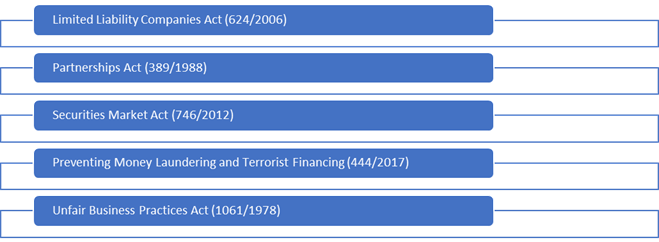
- Limited Liability Companies Act (624/2006)
This law provides rules for private and public limited liability companies (LLCs). It regulates companies in the trade register, outlines the roles of directors and shareholders, and ensures transparent corporate governance.
- Partnerships Act (389/1988)
The act governs general and limited partnerships in Finland. It outlines the regulatory framework of partnership firms, including formation, operation, and dissolution. It decides the liabilities of all partners against the firm and provides rules for settling disputes.
- Securities Market Act (746/2012)
The Securities Market Act is the main legislation that governs and protects Finland’s securities markets. It outlines rules for the allocation of securities, market manipulation-related abuse prevention, foreign investments, and information disclosures.
- Act on Preventing Money Laundering and Terrorist Financing (444/2017)
This act provides measures to prevent money laundering and terrorist financing. It requires businesses to investigate and monitor illegal activities through AML and counter-terrorist financing (CFT) principles.
- Unfair Business Practices Act (1061/1978)
The Unfair Business Practices Act ensures that all businesses, including legal entities and partnership firms, must adhere to ethical behaviour. It also provides regulations for information disclosure concerning the protection of trade secrets.
Benefits of Starting a Business in Finland
Discover the following benefits of starting a business in Finland:

Flexible Regulatory Environment
With a stable and flexible legal environment in Finland, you can easily register an LLC in just 7 days.
Access to European Markets
Finland is a member of the European Union (EU), which helps foreigners get easy access to over 500 million consumers with little to no trade obstructions. Finland, being a Schengen country, eliminates internal customs control, simplifies the transportation of goods and services with less paperwork, and strengthens the economic collaborations with other Schengen countries in the EU.
Skilled Workforce
With a highly educated and technologically advanced population, Finland offers a skilled workforce, especially in IT and R&D sectors, so if you’re planning to start a business in Finland then you’ll have an abundance of skilled workforce waiting for you.
Strategic Location
Finland is located in northern Europe, which facilitates easy trade with countries like Sweden, Norway, Russia, Estonia, and the United Kingdom (UK).
Foreign Tax Advantages
Finland has double taxation agreements (DTAs) with 86 countries, so if you’re a Finnish resident for tax purposes, then you can offset your foreign income tax against your income tax payable in Finland. Companies have the advantage of carrying forward unused foreign tax credits for up to 5 years.
EU Free Trade Agreements
Since its membership with the European Union (EU), Finland has benefited from over 40 free trade agreements (FTAs) with over 70 countries. With these agreements, foreign trade has become more flexible due to fewer tariffs and customs duties.
No Minimum Share Requirement
Finland’s private limited liability companies have no minimum paid-up capital requirement. You can start an LLC with just one euro.
Zero VAT in the EU
The 0% VAT applies to the purchase and sale of goods to other EU countries, which would strengthen business operations throughout Europe.
Tax incentives on R&D
The Finnish tax law provides a 100% tax deduction on research and development (R&D) expenses. It also provides a 150% deduction for tax years up to 2027.
Low Corporate Tax Rate
Finland has a 20% corporation tax rate, which is comparatively lower than most EU countries, making it an attractive business spot for global entrepreneurs.
Start and Manage your Business in Finland
Business Registration in Finland grants access to a market with over 450 million consumers. Partner with Enterworld for Finland company formation and tax filing.
- Registration in 1 Week
- EU Membership Benefits
- 200+ Local Consultants in Finland

Types of Business Structure in Finland
Explore the below-mentioned business structure for starting a company in Finland:
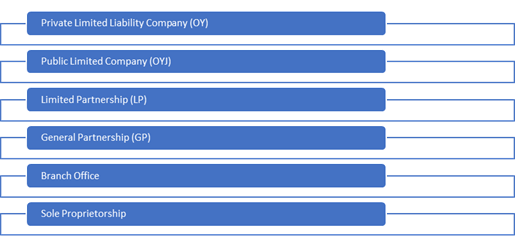
Private Limited Liability Company (OY)
A private limited liability company (LLC), also known as a private limited company, is the most common type of business structure in Finland. It has no minimum share requirement. Foreign entrepreneurs prefer this structure because the shareholders or members have limited liability against the company’s debts.
Public Limited Company (OYJ)
A public limited company is suitable for larger organizations that seek external funding through Finland’s stock exchange. An OYJ must have at least three board directors and one managing director. The minimum share capital requirement stands at EUR 80,000.
General Partnership (GP)
A general partnership consists of at least two members who have an equal share in responsibilities and profits. There’s no minimum paid-up capital requirement. The member’s assets are used to offset the partnership’s debts. All members have unlimited liabilities.
Limited Partnership (LP)
This structure consists of at least two members, one being a general partner who retains unlimited liability and a limited partner who acts as a silent investor with no actual participation in the firm and has limited liability against the firm’s debts.
Branch Entity
A branch entity is just an extension of a foreign parent company. It is not a separate legal entity and works as per the rules of its parent organization, and the latter is responsible for all debts and liabilities of its branch.
Cooperative Association
A cooperative association doesn’t have a predetermined structure. It is formed by at least three members. The members aren’t personally held liable against the association’s liabilities.
Sole Proprietorship (SP)
It is a one-member business establishment. The sole proprietor retains all the profits and has unlimited liability against the firm’s debts.
Who Can Start a Business in Finland?
Check out the eligibility criteria as listed below to start a business in Finland:
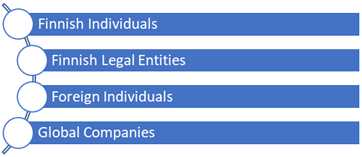
- All Finnish individuals & corporations residing in Finland or anywhere in the European Economic Area (EEA) are eligible to start a business in Finland.
- Foreign entrepreneurs & companies are also eligible to operate a legitimate economic activity in Finland, provided they obtain residency or start-up permits, whichever applies to them. They must also hire a local director within the EEA.
Regulatory Requirements to Start a Business in Finland
The list of regulatory requirements for starting a business in Finland is as follows:
- At least one director and two shareholders for Private Limited Liability Companies (OY).
- At least one director who resides in the European Economic Area (EEA) for foreign applicants.
- Paid-up capital requirement of EUR 80,000 for Public Limited Liability Companies (OYJ).
- A registered office in Finland (physical or virtual).
- Residency or start-up entrepreneur permits for applicants who want to stay in Finland.
- There’s no minimum paid-up capital requirement for private limited liability companies (LLCs).
- A local representative agent is needed if you’re a foreign applicant and reside outside the EEA.
Documents Required to Start a Business in Finland
Take a glance at the mandatory documentation required to start a company in Finland:
- Business Strategy Plan
- Passport Copies of all Directors & Shareholders
- Name Reservation Certificate
- ID & Address Proofs of Directors & Shareholders
- A Minimum Capital Requirement Statement, if Applicable
- Company’s Physical or Virtual Address Proof
How to Register a Business in Finland?
The process of setting up a business in Finland is as follows:
- Make a Business Plan
Although not a mandatory step, it is advisable for all business enthusiasts to chart out a detailed business plan before applying with Finland’s trade register.
- Business Structure Selection
After outlining the business plan and strategies, the applicant must choose a suitable company structure, such as a limited liability company (LLC) structure, which is the most beneficial form because it protects the shareholders against the company’s liabilities.
- Name Reservation
The next step is to search and reserve a company name with the Finnish Patent and Registration Office (PRH). The name should be unique and shouldn’t conflict with Finland’s laws.
- Document Submission
After reserving the business name, the applicant must submit the company registration form with documents like passport copies of directors and shareholders, memorandum of association (MOA), articles of association (AOA), and a statement of minimum paid-up capital to the Finnish Patent and Registration Office (PRH).
- Business Registration Approval
Finland’s trade authority will examine the documents and grant the certificate for company registration in Finland.
- Receive a Business ID
After receiving the certificate of registration, the applicant should make a note of their unique business ID (Y-tunnus) for tax registration, license approvals, and visa permits.
- Tax Registration
After obtaining the business registration, the new LLC owner must register with the Finnish Tax Administration to acquire a tax identification and VAT number or both, whichever is applicable.
- Obtain Necessary Licenses
All companies need various industry-specific licenses and permits to officially commence their business operations. Licenses include logistic services, shop establishment, healthcare, drug manufacturing, and restaurant licenses.
- Bank Account Setup
Following the approval of licenses, the company must open a corporate bank account to handle its expenses and finances.
- Acquire Insurance for Employees
The LLC must register with the Finnish Social Insurance Institution (KELA) and obtain medical insurance for its employees.
- Get Residency Permits
You must obtain a residency visa if you’re planning to stay in Finland. Most common visas include start-up, specific expert, general work, Schengen-C, and Schengen-D visas.
Timeframe for Finland Business Setup
The company formation process is simple and easy. It takes at least 5 to 7 days to register a company in Finland. However, this timeline depends on the business structure and examination process by the Finnish trade authority.
Visa & Permits
Explore the below-mentioned visa options before setting up a business in Finland:

Schengen Visa
Also known as a short-term visa, enables businesses and individuals to reside in Finland or anywhere in the Schengen area for up to 90 days within 180 days for business or tourism purposes.
C-Type Visa
A C-type visa, also referred to as a long-term visa, is valid for five years. This visa includes two options: single entry, which allows foreign entrepreneurs to stay in Finland for 90 days in 180 days, and multi-entry, which allows two entries in the same period.
Startup Entrepreneur
This visa is specifically for individuals and entrepreneurs who wish to establish a startup in Finland. The eligibility criteria include distinct business activity, a detailed business plan, and a proper funding source.
Residence Permit for Experts
A residency visa permit is mainly designed for experts who either own or work in IT, software development, and research companies.
Annual Compliance Obligations After Business Set Up
Take note of the following compliance requirements after the business is set up in Finland:
- Submit annual financial reports to the Finnish Patent and Registration Office (PRH).
- File annual tax returns within the four months following the end of the last month of the accounting period.
- Obtain intellectual properties (IPs), including patents, copyrights, or trademarks, with the Finnish Patent and Registration Office (PRH).
- Conduct and record annual general meetings (AGM) with company managing directors, shareholders, and other necessary personnel.
- Maintain updated records of all directors and shareholders.
- Hire auditors and company secretaries to ensure proper internal governance.
- Submit the ultimate beneficial ownership (UBO) declaration to the Finnish Trade Register (PRH).
- File and pay VAT to the Finnish Tax Administration (FTA), if applicable
- Timely renew industry-specific licenses.
Challenges of Setting up a Business in Finland
Go through the following challenges of setting up a business in Finland:
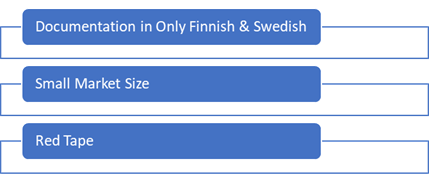
Language Barrier
The Finnish company law requires all official documentation to be in Finnish or Swedish, which could be a hassle for non-native foreigners. All global entrepreneurs must hire a local representative to get assistance in navigating the company registration and regulatory approvals in Finland’s official languages.
Complex Laws
Company formation is easy, but obtaining industry-specific licenses could be challenging, given the complexity associated with the approval process and the higher degree of bureaucracy.
Small Market
Finland has a relatively smaller market compared to the rest of Europe. With just a 5.6 million population, the market size is limited, which could be a demotivating factor for start-ups looking for international ventures.
Conclusion
To sum up everything, business registration in Finland is an easy and smooth process. With advanced infrastructure and the EU market access to tax benefits for startups and tariff-free flow of products and services in the Schengen area, Finland shows a lot of promise for foreign entrepreneurs looking to venture into the European market.
However, obtaining a company registration requires overcoming language barriers and navigating complex regulatory frameworks with strategic planning and professional support. By leveraging Finland’s progressive tax system, government support for startups, and fast-growing industries, foreign entrepreneurs can venture into the realm of endless business opportunities.
Despite the challenges, there are various benefits, such as legislative support for R&D and innovation companies, a well-educated workforce, a strategic location, and low VAT rates for specific industries. So, start a business and increase your wealth because there’s no wealth tax in Finland.
To get expert guidance on company registration in Finland, visit https://enterworld.io/
Frequently Asked Questions About Business Structure in Finland
The advantages of starting a private LLC in Finland are as follows:
Foreign tax incentives through double taxation agreements (DTAs) with 86 countries.
Special tax deductions for R&D and innovative businesses
High-tech infrastructure
Flexible regulatory requirements for initial company formation.
Access to diverse consumer markets of the European Union (EU).
Tariff-free movement of goods and services in Schengen countries
Fewer customs duties and taxes through EU trade agreements and free zones.
20% is the standard company tax rate in Finland. However, foreigners can obtain tax credits on income earned abroad through Finland’s many tax treaties.
The Finnish Patent and Registration Office (PRH) is the main governmental agency that governs company formation in Finland.
Foreigners are eligible to start a business in Finland, provided they hire a local registered agent who is a Finnish resident to represent them before various governmental bodies.
Only Finnish and Swedish language is accepted for company registration forms in Finland. All foreign applicants must attach the supporting documents in the prescribed languages only.
The list of business structures in Finland is as follows:
Limited liability company (LLC)
Public limited company (PLC)
Limited partnership (LP)
General partnership (GP)
Branch Office (BO)
Sole Proprietorship (SP)
The step-by-step process to establish a company in Finland is as follows:
Business activity selection
Choose a company structure
Chart out a business plan
Reserve the company name
Submit the registration application form with mandatory documents like passport copies of all directors and shareholders, MOA, and AOA to the trade register
Get company approval and obtain the business register
Register for tax and VAT with the Finnish Tax Administration
Open a bank account
Register for Social Security and obtain employee insurance
Obtain necessary business-specific licenses
Acquire residency and visa permits
All companies must obtain specific business licenses after company formation in Finland. The list is as follows:
Car manufacturers
Restaurants
Beauty Salons
Apparel and fabric production companies
Import and export businesses
Logistics & transportation services
Online passenger transport service providers
Medical practitioners and equipment-selling companies
Private security corporations
Consultancy and business-managed service providers
Chemical plants and companies
The Finnish trade register usually takes at least 7 days to approve a company registration application.
A private limited liability company (LLC) is the most advantageous business structure because it doesn’t have any cap on the maximum number of members or shareholders. As a foreigner, you can set up a private LLC with just two members with no minimum capital.
Below are the necessary documents required for business formation:
Memorandum of Association (MOA)
Articles of Association (AOA)
Passport copies of all shareholders and directors
Business name reservation certificate
The company’s virtual or local address proof
Identification and address proof of stakeholders and managing directors.
Share allocation certificates, if any
All global entrepreneurs must hire a director based in the European Economic Area (EEA).
Foreigners can start a limited liability company (LLC) in Finland for just EUR 280 through the online mode. The cost to set up a branch office is EUR 370.
The types of visa permits are as follows:
Short Term
Long Term
Start-up Entrepreneur
Specialist Residence Permit
Yes, all foreigners must hire local authorized service agents to represent themselves for business formation in Finland. A local agent would help you:
Register your company
Navigate the complex compliances
Open a corporate bank account
Obtain licenses and work permits.
The VAT registration threshold stands at EUR 20,000. This new mandate started applying from January 1, 2025. All business must use their business ID to log in to the MyTax portal of the Finnish Tax Administration (FTA)
The Finnish Immigration Service takes around 15 days to approve a short stay or Schengen visa permit for business-related stays.

Florida LLC for Amazon FBA: Ultimate 2026 Guide...
Mar 16, 2026

How to Register a Company in Dubai Silicon Oasis...
Mar 10, 2026

How to Start Logistics Business in Oman in 2026?...
Mar 03, 2026

How to Start an Interior Design Company in Dubai...
Feb 25, 2026
The Top 8 Benefits of Incorporating a Company in...
Feb 02, 2026
Startup Tax Exemption Singapore 2026: A Complete...
Jan 28, 2026

Australia Corporate Tax & Incentives: Update...
Jan 22, 2026

How to Set Up a Company in the United States: 20...
Jan 22, 2026

Annual Compliance Calendar in Australia 2026: Al...
Jan 21, 2026

Foreign Ownership Rules in the United States: Wh...
Jan 20, 2026