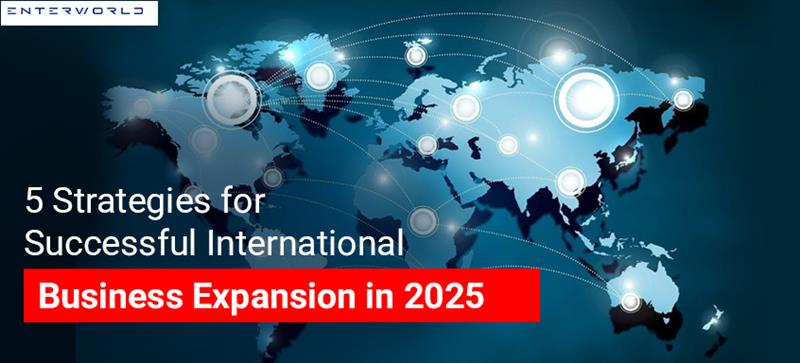
In 2025, the global economy is expected to grow by 3.3%, which is below the historical average of 3.7%. This environment presents both challenges and opportunities for businesses aiming to expand internationally.
Technology has advanced, trade policies are evolving, and market conditions are shifting, making it an opportune time to expand beyond domestic borders. However, effective international business expansion in 2025 requires detailed planning and execution.
Benefits of International Business Expansion in 2025
International business expansion in 2025 provides a variety of advantages:
Revenue Diversification: This allows the organization to reduce dependency on one market and thereby share risk across multiple markets.
Access to New Customers: The emergence of new markets allows an organization to access new customers who are becoming more reliant and creating more demand.
Improved Innovation: Operating in diverse markets and interacting with different customers stimulates creative thinking and results in new products or services.
Economies of Scale: Companies can benefit from the cost advantages associated with increased levels of production and distribution.
Competitive Advantage: Companies can establish a brand that creates value for customers and establishes stronger recognition and competition in multiple markets.
Types of International Expansion Models
Companies engage in international expansion through a variety of market entry strategies; consider your goals and resources. Some of the common international expansion activities an organization engages in include:
Licensing and Franchising: When organizations provide someone (a foreign entity) rights to use or earn money from their trademark and/or products.
Mergers and Acquisitions (M&A): When an organization merges with or acquires an existing organization in a foreign market.
Exporting: Sell goods/services to customers in foreign markets
Joint Ventures and Strategic Alliance: Teaming up with local history and market knowledge to share and pool resources
Foreign Direct Investment (FDI): Either opening new operations or acquiring businesses in the target country.
Employer of Record (EOR): Contracting a service provider to employ, comply with, and process payroll in the foreign market.
Strategies for International Business Expansion
Have a look at the strategies for international business expansion-
- Market-Driven, Feasibility-Based Research
Businesses must understand when and where they can grow before they engage resources for an international expansion. In 2025, market research is no longer an option; it is the roadmap for success.
Key Actions:
- Evaluate demand, market trends, and consumer behaviour in target areas
- Identify local competitors and price points
- Understand economic indicators, legal frameworks, and the political environment
- Make sure you leverage industry-specific research and consulting to properly develop your entry strategy
Impact:
The risk of making decisions without careful research is too high. Real-time research helps you identify opportunities before you take risks. Also, considering political factors, especially with the fast changes happening globally, lets you closely monitor shifts in your local or new markets. This approach gives you the confidence to make informed decisions before making significant changes.
- Create Local Strategic Alliances and Networks
Going global does not mean going it alone. Work with local actors in your new market for agility, legitimacy, and access to their established networks and systems.
Key Actions:
- Engage directly with local distributors, suppliers, and consultants.
- Participate in trade missions and government investment events.
- Form partnerships with economic development organizations to aid in compliance and licensing processes.
- Develop strong relationships to help reduce any cross-cultural and regulatory issues.
Impact:
Having local relationships provides ease to enter new markets, gives your brand credibility, and allows for things to scale quickly and easily to respond to local context.
- Select the Right Market Entry Model to Scale
There is no single model. The appropriate market entry mode also depends on the maturity of your business, capital, the type of product, and the number of risks you are comfortable taking.
Common Models:
- Exporting or Licensing – Least risk and quickest access to the market
- Joint Ventures and/or Alliances – You share the cost and have the benefit of local knowledge
- FDI or Wholly Owned Subsidiary – Best for long-term control and brand presence
- Representative Office/Branch Office – sectors such as IT, defence, or regulated matters
Impact:
Selecting a model that matches your resources and your strategic vision allows you to avoid overextending yourself and for your program to have a solid foundation for smart and sustainable growth.
- Use Digital Innovation and Localize
In 2025, technology will be your best friend to achieve global reach and local relevance.
Key Actions:
Localization of all your digital assets – websites, marketing, and customer service
- Automation to manage operations and CRM for intelligence and efficiency, and AI for content development.
- Engagement with analytics for informed data-driven decision-making.
- Adapt marketing using localized SEO and regional platforms.
Impact:
Digital readiness provides operating flexibility, enhanced customer experience, and enables data-informed decision-making while remaining locally relevant.
- Scale Slowly and be Compliant and Sustainable
Moving to broader markets, it is recommended to go slow so you can learn what you can before you make a full commitment. This also allows for sustainable practices from the start, building credibility and long-term resilience.
Recommended actions:
- Conduct pilot programs to establish your product-market fit.
- Determine tracking KPIs, including market share, CAC, brand awareness, etc.
- Sustainability in practice from Day 1 (e.g., sustainable sourcing, ethics, ESG compliance).
- Research regulatory changes and market trends continuously.
Impact:
In a world of informed consumers and increased regulatory controls, this will gain trust rather than reputational damage with lost resources, and data-based information will be utilized efficiently.
Whether you are striving for business expansion or looking for company registration in Malaysia or eyeing company formation in British Virgin Islands, talk to Enterworld consultants.
Challenges of Global Expansion & How to Overcome Them
Given below are the challenges of global expansion in 2025, and here’s ways to overcome them-
Legal Hurdles: There will be regulatory uncertainty and complexity, so to mitigate these risks, you can partner with firms that have legal experience or utilize EOR (Employer-of-Record) firms.
Cultural Barriers: Your understanding of culture is limited, but focusing on managing the details, including cultural formalities and reference areas, may contribute to attaining success. Consider investment in culture training or specific local market research.
Supply Chain Management: Your supply chain and logistics may be slow and costly in new markets. Leveraging relationships with suppliers and logistics will enable greater speed in successfully establishing your supply chain.
Talent Acquisition: Recruitment and managing people in a foreign market can be difficult. Some of the difficulties can be resolved through EOR services, which simplify the hiring process and compliance.
Financial Planning and Risk Management: Economic considerations, fluctuations, or political instability may affect your ability to make a profit. Conducting a comprehensive financial analysis and assessing the overall need to diversify investments may account for some of the risks.
Why Enterworld for International Business Expansion?
Enterworld is the world’s leading business consulting firm for international business expansion. We have expert professionals in 100+ countries, including India, Dubai, Australia, Sri Lanka, Panama, Mauritius, Mexico, Marshall Islands, and other countries.
We offer end-to-end business consulting solutions. Whether you are seeking company registration in France or looking for a business setup in Mexico, we are here to help you out. From tax filing to managing compliance, we take care of everything for you.
To Wrap Up
Expanding internationally in 2025 offers some major opportunities for growth and diversification. In every case, conducting comprehensive market research, forming local partnerships, adapting local culture and legal norms, leveraging technology, and expanding gradually will help manage the complexity associated with global expansion.
Utilizing planning to foresee challenges, overcoming them with local expertise will lay the groundwork for future success in the international market.
To get expert assistance in international business expansion in 2025, visit https://enterworld.io/.
Frequently Asked Questions About Benefits of International Business Expansion
Entering new international markets in 2025 helps businesses target new customers and reduce reliance on one market. With the increasing demand from consumers in new and emerging economies and the ease of access via the digital world, companies can achieve accelerated growth and become increasingly competitive. While there will still be normal barriers to entering international markets, now is a great time to go global as companies can diversify their income, reduce their risks, and build their brand globally.
Exporting is when a company sells its products to customers in other countries. There are many ways to export, including online sales, local distributors, or shipping it directly to customers. Exporting is generally considered the first and simplest aspect of going global, as it does not necessitate opening offices or hiring staff within the foreign market.
Export market research allows you to understand the needs of the customer, their buying habits, pricing, competitors, and legal rules in the new country. Without research, you run the risk of entering a market that is undeveloped or not ready for your business. Research will help you make informed business decisions, reduce expensive mistakes, and give your new international market the best chance of success.
You should assess local customer trends, culture and behaviour, price and competition, economic indicators, and government policies. This information determines if your product fits the market and what changes you may need to make. Good research saves time and money while also informing your strategy for successful international entry.
Exporting and licensing will allow for fast access to markets because they are low-investment and allow quick market testing. Exporting and licensing are a good fit for small to mid-market businesses looking to expand into foreign markets without unnecessary risk, while granting the time to gauge their business plan in a foreign market without a large capital input.
Businesses often measure success by looking at their sales, market share, customer growth, and brand awareness metrics. Many then track the amount spent on customer acquisition and whether any of those new customers ever repeat. The numbers then serve as an indicator of whether their international strategy is successful or if it needs improvement.
There are numerous challenges, including working with foreign law, culture, language, supply chain, and human resource limits. There are also the challenges of foreign market uncertainties surrounding economic and political stability that could impact profit. Some of these limitations are common but could cause delays or disorganization. Knowing these limitations in advance, proper planning, having knowledgeable experts in the industry, and relying on local decision-makers alone or as partners are good approaches to tackle common issues.
Companies can work with local advice (legal) professionals or use Employer of Record (EOR) services to ensure they are legally compliant. These professionals, whether through an EOR service or as an independent advisor, will help with licensing, taxes, labor laws, tax treaties, and permits. Compliance with local requirements from the outset will avoid fines and penalties while developing a solid reputation for being a trustworthy company.
To manage supply chains successfully, it is essential to develop solid working partnerships at the outset with local logistics providers and suppliers. Operating in unknown markets requires systems that put you at ease about movements. Visibility software can help track shipments and, more importantly, effectively manage inventory and stock levels. Planning all the details for logistics, transportation routes, backup options, risk management types, and costs can minimize disruptions so your new business reputation can continue smoothly in foreign markets.
Companies should be aware of and prepare for currency fluctuations, inflation, and general political unrest. Each of these factors has implications for profit margins, operational controls, and stakeholder management. When preparing your strategic approach, you might consider global diversification, locking in exchange rates, or using insurance against loss. A strong financial plan can insulate companies, continue as expected or even exceed plans, while others remain susceptible to the unexpected nature of the economic climate in a new foreign market.
Florida LLC for Amazon FBA: Ultimate 2026 Guide...
Mar 16, 2026
How to Register a Company in Dubai Silicon Oasis...
Mar 10, 2026
How to Start Logistics Business in Oman in 2026?...
Mar 03, 2026

How to Start an Interior Design Company in Dubai...
Feb 25, 2026
The Top 8 Benefits of Incorporating a Company in...
Feb 02, 2026
Startup Tax Exemption Singapore 2026: A Complete...
Jan 28, 2026

Australia Corporate Tax & Incentives: Update...
Jan 22, 2026
How to Set Up a Company in the United States: 20...
Jan 22, 2026

Annual Compliance Calendar in Australia 2026: Al...
Jan 21, 2026

Foreign Ownership Rules in the United States: Wh...
Jan 20, 2026