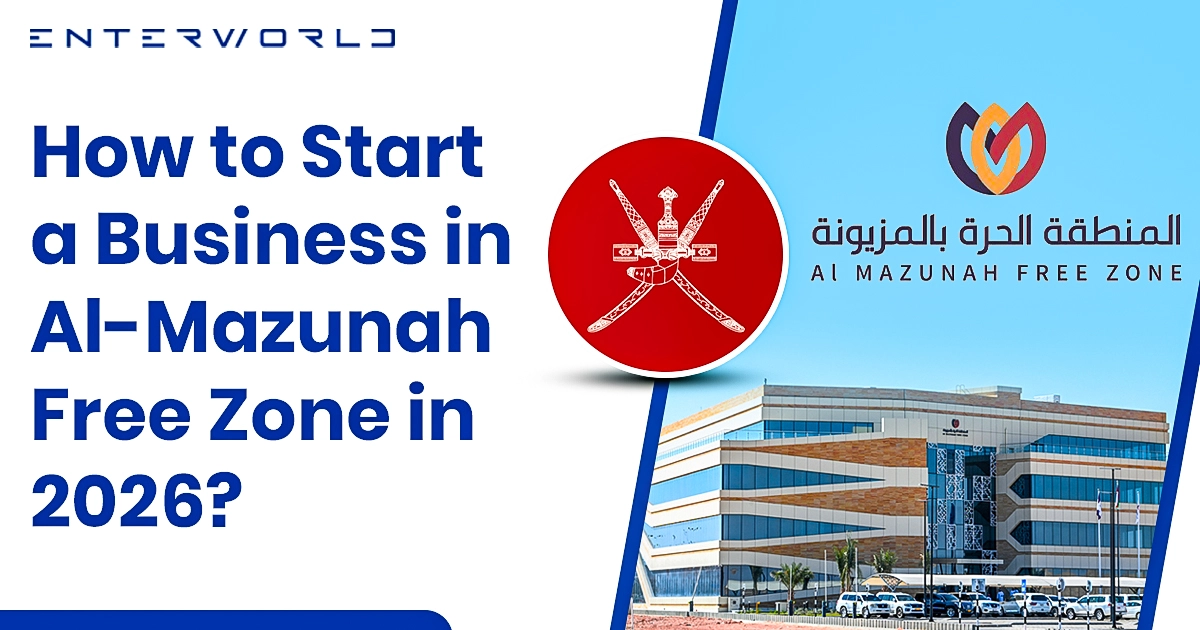
Al-Mazunah Free Zone has evolved as a strategic business hub for investors seeking to set up or expand their presence within the region or marketplace. Well known for its cost-efficient setup, investor-friendly regulations, and proximity to key border routes, the free zone also provides a perfect environment for industrial, trading, and logistics businesses.
With simplified licensing procedures, custom and tax advantages, along with flexible ownership options, Al-Mazunah Free Zone attracts a large number of startups, SMEs, and similar companies in 2026. Understanding the business setup procedures, requirements, and advantages is crucial for making the correct decisions.
This blog offers a clear overview of how to start a business in Al-Mazunah Free Zone successfully, and other related crucial aspects that you must know.
Introduction to Al-Mazunah Free Zone
The Al-Mazunah Free Zone is an economically developed zone created to facilitate trade, manufacturing, and logistics transactions across international borders. Being close to an international border, the zone presents an attractive and efficient business environment, taking into account the ease of setting up the business at a relatively low cost. The free zone is highly attractive to foreign investors as well as to small to medium-sized businesses.
If you are a business enthusiast with a vision of establishing your business legacy in Oman, opting for Al-Mazunah Free Zone for your Oman business setup can be a great move.
An Overview and Strategic Location of Al-Mazunah Free Zone
Al Mazunah Free Zone is located close to a large land border, which makes it an extremely crucial gateway for sourcing goods from regional as well as international markets. Its location helps in smooth transportation, lowers logistics costs, and increases the speed of movement of goods.
In addition, it is closely linked with roads and customs, ensuring completely hassle-free import and export activities. Created for serving industrial, commercial, and trading activities, Al Mazunah Free Zone offers state-of-the-art infrastructure, warehousing services, and industrial plots that make it an extremely good choice for enterprises interested in serving neighbouring markets.
Read more – How to Register a Company in Oman as a Foreigner?
Importance of Al-Mazunah Free Zone for Investors and SMEs
Al-Mazunah Free Zone also supports investors and fosters the development of SMEs with its low-cost and flexible business environment. The incentives that this zone offers include tax benefits, customs exemptions, and the easiest licensing procedures, allowing more and more companies to enter the zone.
It provides SMEs with low operational costs, easy market access in the region, and an infrastructure with scalability in mind. Foreign investors find ownership flexibility and simplified regulatory processes in the free zone. These advantages make Al-Mazunah Free Zone a tempting destination for startups, manufacturers, and trading companies for sustainable expansion and competitive positioning.
Understanding Al-Mazunah Free Zone Business Environment
The environment in Al-Mazunah Free Zone is organized to promote efficiency, transparency, and investor confidence. This is assured by the availability of rules, which in turn provide a stable business environment to facilitate trading, industrial, and business activities.
Regulatory Framework and Governing Authorities
Many countries today, Al Mazunah Free Zone follows an organized regulatory framework that is supervised by specific free zone authorities as well as the relevant government agencies. The regulatory framework allows for simple business setup procedures while ensuring complete transparency from the business perspective.
It can be stated that organized business setup procedures with proper information on ownership structures, licensing, workforce, and operational aspects make business setup quite easier. The presence of administrative facilities within the free zones helps in obtaining approvals from the customs and immigration authorities quickly, so that smooth business operations can be ensured.
Economic Activities Permitted in Al-Mazunah Free Zone
All types of economic activities are allowed in Al-Mazunah Free Zone to make the free zone attractive to different types of businesses. These activities include trading, industry, assembly, logistics, warehousing, and some service sectors.
Industrial enterprises enjoy the advantage of the allocated plots and the supply of utilities, while the trading firms enjoy the advantage of easy import and export procedures. The logistics firms enjoy the advantages of the free zone’s proximity to the border terminals and the transportation links to the free zones.
Benefits of Starting a Business in Al-Mazunah Free Zone in 2026
Establishment of a business in Al-Mazunah Free Zone comes with several advantages that promote growth, cost savings, and market development. Such advantages are aimed at encouraging international investors and SMEs.
Tax Exemptions and Customs Advantages
A key advantage of the Al-Mazunah Free Zone is the incentivizing tax and customs exemption package that results in lowered operating costs. Most business entities operating within the zone are treated to a customs duty exemption on imports and exports, ensuring that international business and trading activities are less expensive.
Another upside of the custom exemptions and simplification of processing procedures within the zone is the increased operating efficiency achieved by minimizing processing times and operating hassles. Businesses will benefit from the tax-friendly operating and business environment and, hence, invest in development and improvement strategies to boost competitiveness and sustainability.
Ownership Benefits and Foreign Investment Incentives
One of the main advantages of Al-Mazunah Free Zone is flexibility in business ownership. Foreign investors will have options of full ownership, hence dispensing with the need for local partners. This ownership structure offers better control over the running and decision-making of the businesses. Other incentives to invest, such as simplified licensing and fewer regulatory requirements, make this free zone highly attractive for international entrepreneurs and companies seeking presence throughout the region.
Infrastructure, Logistics, and Market Access
Al-Mazunah Free Zone features modern infrastructure that supports industrial, trading, and logistics operations. It offers a range of services to business enterprises, including access to warehouses, industrial plots, and dependable utilities. Its proximity to major roads and transport routes, as well as border crossing points, makes it highly accessible, guaranteeing a successful entry into the market. This assures a faster service for regional and international markets, less costly logistics, and easier supply chains.
Read more – How to Register a Company in Turkey as a Foreigner?
Types of Business Licenses in Al-Mazunah Free Zone
There are different types of licenses offered by Al-Mazunah Free Zone based on the nature of the business. This is to ensure the license is tailored to fit the required operations for the business to be able to function within the free zone.
Trading License
Al-Mazunah Free Zone’s trading license enables traders to import, export, distribute, and warehouse various products. This license is an appropriate choice for those involved in wholesale trading activities, regional distribution, and cross-border trading transactions. The simplified procedures offered by the free zone in relation to trading processes, as well as the zone’s location, make it an ideal place to establish trading businesses.
Industrial License
This industrial license is created to handle the operations of production, assembly, and further processing in the Al-Mazunah Free Zone. By obtaining the industrial license, producers will be in a position to create their products by using raw materials or semi-manufactured goods to be exported to markets in the region as well as to the global marketplace. Other advantages offered by the free zone will support the producers in handling their operations in a less costly manner.
Service and Commercial Licenses
Service and commercial licenses pertain to servicing sectors such as logistics, consulting, repairs, and support. This type of license will be applicable for businesses that do not involve manufacturing but fall into the non-manufacturing sector of the free zone. The open licensing system allows service enterprises to run their business with ease and take advantage of the facilities offered by the free zones.
Legal Structures Allowed in Al-Mazunah Free Zone
The Al-Mazunah Free Zone allows investors the flexibility of setting up their businesses under different legal forms that depend upon the ownership pattern and size of the companies.
Free Zone Establishment (FZE)
This type of business entity structure is suited for one shareholder. It may be individual or corporate. Full ownership rights with liability protection are ensured for the individual or the corporation that chooses the FZE business entity structure.
It is an appropriate business entity structure for entrepreneurs who want complete control over the business operations. It also provides a simplified business entity structure for the entrepreneurs. The establishment procedure of an FZE business entity structure involves simple capital requirements. It proves an economical business entity structure for entrepreneurs investing individually. It helps them perform business operations conveniently in the Al Mazunah Free Zone.
Free Zone Company (FZC) and Branch Offices
A Free Zone Company (FZC) is created with more than one partner. Thus, it is ideal for partnerships and joint ventures. This structure gives limited liability protection and sharing of ownership, as companies can share resources and expertise together.
Conversely, the Al-Mazunah Free Zone allows the establishment of branches of both local and foreign businesses. Branches function as enterprises with the same name as the parent companies, existing businesses can expand to the new location rather than incorporating an entirely new company.
Step-by-Step Process to Start a Business in Al-Mazunah Free Zone
Establishing a business within the Al-Mazunah Free Zone entails a systematic and clear procedure. Every step is set to ensure that it is free from any violations while enabling investors to set up their businesses without any complications.
Step 1 – Business Activity Selection and Feasibility Assessment
The next step in choosing a free zone is identifying a corresponding business activity among those allowed in the free zone. Investors are required to conduct a feasibility study to assess demand in addition to costs to ensure they select a business model that is in line with the framework and vision of the free zone.
Step 2 – Company Name Reservation & Initial Approval
After completing business activity, investors are required to select an appropriate business name that complies with rules and regulations. This business name is then put up for approval. The selected business name will be analyzed to check whether it adheres to business nomenclature rules and whether it already exists. Initial approval follows, which confirms that investors can move forward with the registration process.
Step 3 – License Application and Documentation Requirements
At this level, the application for the license is submitted by the applicant together with the required documents, which may include information about the shareholders, identification, as well as business plans, if any. This is before the free zone authority assesses the application to conform to the required regulation standards.
Step 4 – Office Space, Warehouse, or Industrial Unit Allocation
Based on the kind of business undertaken, the investors need to choose suitable offices, warehousing, or industrial units that are available in the Al-Mazunah Free Zone area. This allocation of space is an obligatory requirement to obtain the license to enable the business to function with an officially recognized base.
Step 5 – Final Approval and Business Registration
Once the requirements are met, the free zone authority issues the final approval and completes the registration of the company. The company is thus formed and has the right to start the business. This process involves obtaining the business license and other registration documents.
Documentation Checklist for Al-Mazunah Free Zone Business Setup
Documentation plays a fundamental role in setting up a business in Al-Mazunah Free Zone. It is very important to ensure that you submit proper documentation to avoid any delay in licensing and registration of your business.
Shareholder and Director Documentation
Shareholders and directors have to provide particular personal documents as well as identification documents to set up the business. Such documents may include copies of passports, photographs, and filled-out application forms.
Documents regarding residential proofs, background information, and proofs of residential as well as background information may be required to be submitted in order to fulfil the criteria of compliance. In particular situations, curriculum vitae/resumes may be required to determine the ability to handle the business. All the documents have to be clear, valid, and, when required, notarized
Corporate Documents for Existing Companies
For companies intending to set up a branch or subsidiary, additional documents will need to be provided. This typically consists of a certificate of incorporation, memorandum and articles of association, board resolutions regarding the formation, and a certificate of good standing.
Documents that have been issued from outside the country may possibly require notarization and legalization. The submission of true corporate documents enables ascertaining the status of the parent company.
Costs and Fees for Business Setup in Al-Mazunah Free Zone
The establishment fees of starting a business in Al-Mazunah Free Zone are also made quite economic and competitive, which is another factor why many startups, SMEs, as well as international business entities, find it highly attractive to operate from this free zone. The fees mainly vary depending on the business activity. However, the setup of a business in this free zone is quite cost-effective.
License Fees and Registration Costs
The fees and charges for registration and licenses in Al-Mazunah Free Zone differ depending on the type of business activity and whether it is trading, industry, or services. The fee structure typically includes registration fees for a company, initial approval fees, and subsequent renewal fees. Relative to other locations used as business jurisdictions, it is safe to state that Al-Mazunah Free Zone has a simplified and cost-effective system.
Office Space and Operational Expenses
Office and operational space in Al-Mazunah Free Zone may vary based on facility size and type, including offices, storage space in offices/warehouses, and industrial land plots for investment and expansion. The operational cost may include services such as water and electrical utilities, and administrative services. It should be noted that operational costs can be significantly reduced by making use of cost-effective facilities and infrastructure shares offered by Al-Mazunah Free Zone.
Visa, Employment, and Labor Regulations
Visa matters, labor laws, and the labor sector in Al-Mazunah Free Zone are organized in a way that ensures smooth operation for businesses. The free zone has an easy and organized procedure for the issuance of both investment and labor visas in an organized way and in accordance with labor laws. Such organized labor laws make Al-Mazunah Free Zone an attractive place for conducting business operations for local and foreign investors.
Investor and Employee Visa Process
The visa process in the free zone of Al-Mazunah is streamlined. The investor visa or employee visa is made available to investors or workers after the company has been registered or incorporated. The employee visa is processed based on the nature of the license of the company, office space available in the free zone, or the approved workforce in the free zone. The free zone’s administration provides assistance regarding visa procedures and the ease of documentation that needs to be completed.
Employment Regulations and Workforce Requirements
Working regulations in the Al-Mazunah Free Zone ensure a healthy balance between the interests of employers, workers, and the flexibility of the establishment. The enterprises operating in the free zone have to adhere to working regulations as well as rules set out in the employment law of the country. The manpower required for the operation of the enterprise varies depending on its type or size, where hiring approvals are tied to office or industrial space.
Banking, Capital Requirements, and Financial Considerations
Financial banking and investment aspects also form an integral part of a company or enterprise established in Al-Mazunah Free Zone. Businessmen should pay proper attention to financial planning in terms of capital requirements and banking facilities. The free zone also encourages financial transparency, and in this way, businesses and enterprises remain able to deal with financial matters in an excellent way.
Opening a Corporate Bank Account
After incorporating their business in Al-Mazunah Free Zone, entrepreneurs are then free to open a corporate bank account. This will require them to submit their business incorporation documents, licenses, and their business activities, and sometimes the banks will carry out their own diligence to ensure that their services conform to the required standards. The business will be able to carry out its financial activities effectively with a corporate bank account.
Capital Investment and Financial Compliance
The needs for capital investment in Al-Mazunah Free Zone differ based on the legal form of the organization and the type of activity being developed. In some types of businesses, the minimum share capital may be required, but in others, there is more flexibility with the capital.
The businesses will also comply with the financial regulations and include proper bookkeeping practices, audit requirements if applied, and renewal of licenses on time. Proper financial compliance encompasses corporate transparency, an element that can help generate confidence with relevant authorities and business partners, and also aids in maintaining a sustainable business.
Read more – How to Register a Company in Iceland as a Non-resident?
Compliance, Renewals, and Ongoing Business Obligations
Compliance and ongoing compliance activities are very important to keep a business running smoothly in Al-Mazunah Free Zone. Businesses are required to comply with all regulations, renew their licenses on time, and abide by operational procedures issued by the free zone administration. This ensures a smooth running of the business, which allows it to expand in the free zone without any restrictions.
License Renewal and Annual Compliance
Companies that set up businesses in the Al-Mazunah Free Zone have to renew their licenses on a yearly basis. Renewal of the license usually involves providing the necessary new documentation of the company, payment of renewal costs, ensuring that the lease of the office or warehouse is in effect, or that the type of activity being conducted is consistent with the terms of the approved license. Renewal of the license is important to prevent any kind of dispute or suspension of any kind of activity.
Audits, Reporting, and Regulatory Updates
Depending on the nature and size of the business, companies in Al-Mazunah Free Zone may be required to maintain financial records and submit periodic reports. In some cases, an audit is necessary to satisfy either regulatory requirements or the needs of lenders. It is of similar importance to keep updated with the latest regulatory notices emanating from the free zone authority in case any such notices may affect licensing, employment rules, or operational regulations.
Proactive reporting and audit obligations are basic ways of ensuring transparency, credibility, and preparedness for change.
Common Challenges and How to Overcome Them
This is while Al-Mazunah Free Zone ensures a very encouraging business climate, yet at certain instances, the investors will also face some problems in its setup and operation. These are generally regulatory, sometimes relate to documentation, and often concern market entry. Foreseeing these obstacles well in advance and acting accordingly will assist the businesses in mitigating perils and smoothing the process for an easy, successful establishment in the free zone.
Regulatory and Documentation Challenges
In the initial stages of business setup in Al-Mazunah Free Zone, the challenges an investor encounters are all related to licensing and documentation. Investors have sometimes found difficulty in meeting compliance standards, preparing correct documentation, or understanding licensing requirements. Partial or incomplete, wrongly prepared, or not properly attested documents will lead to delays.
Businesses should endeavour to go through free zone requirements, maintain proper records, and keep documents valid and updated. Consulting experts who understand free zones’ regulations and requirements can help businesses speed up their approvals rather than suffer administrative delays.
Operational and Market Entry Challenges
Operational and market entry issues can occur as businesses start operating in Al-Mazunah Free Zone. These might include issues of handling logistics, finding suitable suppliers, adapting to local conditions in these markets, or structuring distribution channels. Other businesses might also encounter rivalry or pricing factors in these markets as they enter them. Market research, creating effective operational plans, or networking can resolve these challenges. The infrastructure and location of free zones can further facilitate these businesses.
To Wrap Up
Al-Mazunah Free Zone offers a persuasive opportunity for investors, small to medium enterprises, and foreign investors looking for a cost-effective and situated business location. The free zone, with investor-friendly policies, tax and customs benefits, flexible investment requirements, and advanced infrastructure, accommodates all possible business endeavours in the commercial, industrial, and services sectors.
Being close to major border points increases trade and market efficiency, favouring those trading and logistics-driven business endeavours. Furthermore, streamlined licensing and compliance requirements and visas work to avoid administrative complexities and ensure stability and continuity in business. Nonetheless, it is essential to consider all business aspects and requirements before proceeding. For those looking to expand their business and ensure cost-effectiveness and compliance, Al-Mazunah Free Zone can prove to be a rewarding and profitable choice. All set to launch your business in Al-Mazunah Free Zone? Let our experts at Enterworld help you register, run, and manage without any stress.
Frequently Asked Questions
Depending on the industry and business structure, company creation fees might range from OMR 1,000 to 3,000. The annual cost of a business licence is between OMR 200 and OMR 1,000. Office setup costs: OMR 5,000–10,000 per year for commercial space rentals. Labour cards and visas: OMR 200–400 each, plus labor-related costs.
Companies in the free zone that are registered in Dubai are able to buy real estate in certain regions. Typically, the property needs to be located in a freehold area where foreign ownership is permitted. If ownership is in the firm’s name, your company will have direct control over the asset.
Oman now has two Special Economic Zones (Knowledge Oasis Muscat Special Economic Zone and Duqm Special Economic Zone) and three Free Trade Zones (Al Mazunah Free Zone, Sohar Free Zone, and Salalah Free Zone).
Typical expenses for setting up a free zone include: License fees for free zones: OMR 2,500–5,000 per year. Depending on the location and size, office space rentals range from OMR 8,000 to OMR 12,000 per year. Each employee visa costs between OMR 200 and 400.
The primary draw of establishing a business in a UAE free zone is the lack of restrictions on foreign ownership and the independent Free Zone Authority (FZA), which is in charge of granting operating licenses and overseeing the operations of businesses operating within the free zone.
A single shareholder owns 100% of an SPC, whereas multiple shareholders, including both corporate and individual shareholders, possess an LLC.
Depending on the Free Trade Zone and economic activity, registering a Dubai Free Zone Company typically takes two to five business days. When all the necessary paperwork is available, some zones offer same-day registration, making the Dubai Free Zone Business Setup procedure quick and easy.
In free zones, an audit entails a thorough analysis of financial records, operational procedures, and compliance measures within the designated economic zones that provide certain incentives, including tax exemptions and regulatory advantages, to draw in enterprises.
If a taxpayer’s company’s total sales, turnover, or gross receipts surpass Rs. 1 crore throughout the fiscal year, they must undergo a tax audit. Unless 95% of receipts are digital, in which case the threshold is Rs. 75 lakh, this threshold is Rs. 50 lakh for professionals.
Investors benefit from reduced operating expenses, land lease facilities, corporation tax exemption, and exemption from import-export duties. Every zone includes sophisticated infrastructure, including IT parks, warehouses, connecting ports, industrial plots, and logistical systems that integrate customs.
Read more – How to Register a Company in Solomon Islands as a Foreigner?

Florida LLC for Amazon FBA: Ultimate 2026 Guide...
Mar 16, 2026
How to Register a Company in Dubai Silicon Oasis...
Mar 10, 2026

How to Start Logistics Business in Oman in 2026?...
Mar 03, 2026

How to Start an Interior Design Company in Dubai...
Feb 25, 2026

The Top 8 Benefits of Incorporating a Company in...
Feb 02, 2026

Startup Tax Exemption Singapore 2026: A Complete...
Jan 28, 2026

Australia Corporate Tax & Incentives: Update...
Jan 22, 2026

How to Set Up a Company in the United States: 20...
Jan 22, 2026

Annual Compliance Calendar in Australia 2026: Al...
Jan 21, 2026

Foreign Ownership Rules in the United States: Wh...
Jan 20, 2026